I fully understand this might seem like a weird topic, but I watched the Care Bears Movie (1985) as an adult. Thanks to YouTube, I watched something I hadn't set eyes on since before puberty, and I have some things to say. I accept your confusion, but walk with me here.

Like many films of the 1980s, The Care Bears Movie could not be made today, and the reasons aren't what most people would assume. I rewatched it late at night, wired from too much caffeine too late in the day, and expected a charming remembrance of my childhood. Instead, I watched 76 minutes of moral lessons from a high-trust society that no longer exists, prompting a wistful sadness.
If you're too young, or you came from a home where you weren't allowed to watch TV (the horror!), The Care Bears Movie was released in March 1985 by The Samuel Goldwyn Company. Every major American studio had already passed on it. The studios kept saying animated features wouldn't sell if they weren't Disney. Well, joke was on them because the film grossed $23 million domestically, $34 million worldwide by 1989, became the highest-grossing animated feature not produced by Disney, won Canada's Golden Reel Award, and saved Nelvana Studios from bankruptcy. Mickey Rooney narrated, Carole King and John Sebastian wrote songs, and Jackie Burroughs voiced the villain. The thing was a hit, and deservedly so. It also sold a metric F-TON of toys to both boys and girls.
I had a Sunshine Bear plushie, thank you for asking.
But watching it as an adult, I can see how this children's movie succeeded because of the time and place it was produced. It couldn't be repeated now because every bit of that movie took for granted a list of things our culture has since dismantled.
Plot summary, for the uninitiated: Mr. Cherrywood runs an orphanage with his wife and tells the children a bedtime story before lights out. The story features the Care Bears, a group of pastel bears who live in a cloud kingdom called Care-A-Lot and monitor Earth through telescopes for children in distress.
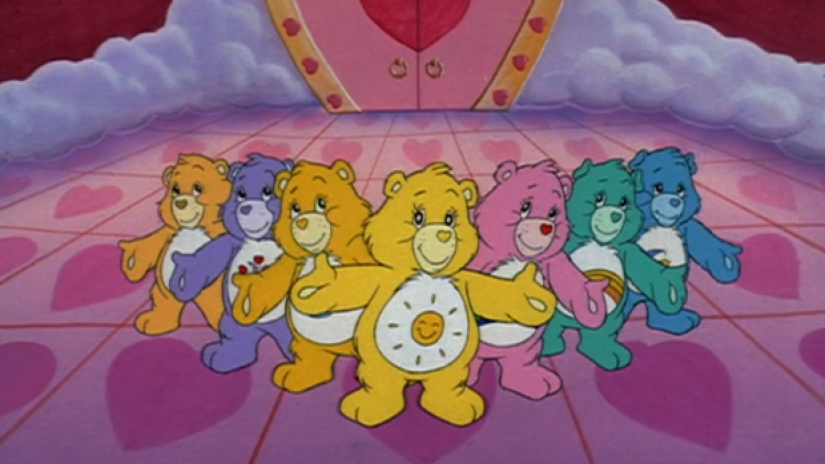
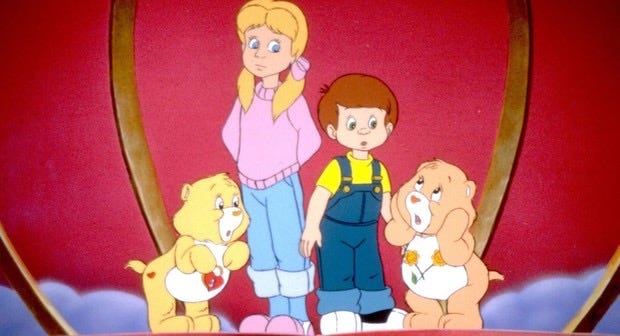
Two of them descend to befriend Kim and Jason, siblings who've lost their parents in a car accident and stopped trusting anyone. A third Care Bear is sent to help Nicholas, a lonely teenage magician's apprentice who finds an old spell book in his master's trunk. The spirit inside the book promises Nicholas friendship and revenge on the people who've ignored him. He accepts the deal. The spirit corrupts him into casting spells that remove caring from people across the world, which threatens to collapse Care-A-Lot itself.
Kim, Jason, the Care Bears, and a related group called the Care Bear Cousins set out to defeat the spirit and save Nicholas. That's the whole movie and, as expected, it features several songs.
The Voice of Malice
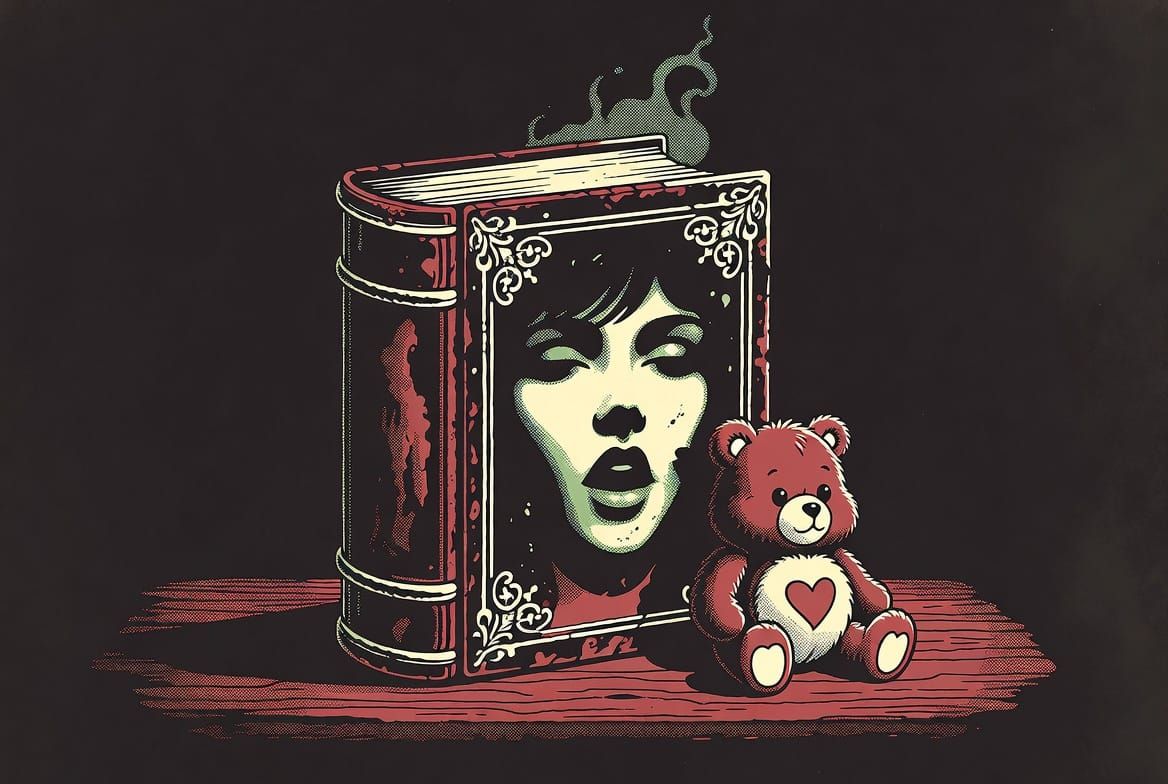
The villain is a sentient spell book with a woman's face inside, voiced by Jackie Burroughs. She's found in a trunk of magical supplies, opened by Nicholas, the lonely teenage magician's apprentice, and she gets to work on him immediately.
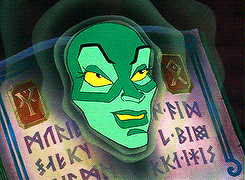
She tells him she'll help him. She tells him the world has been unfair to him. After all, he's never had a friend in his whole life. Why don't people like him? The movie sidesteps the pressing question of how Nicholas could have gone so long without ever having a single person like him. As we adults have all come to know, if a person never has friends and is estranged from his family... it's likely he's the problem.
When Nicholas's stage debut goes wrong (because she's secretly sabotaged it), she tells him the laughing children deserve punishment. She walks him through the spell that makes them attack each other, and they both laugh at the resulting mayhem.
Tenderheart, the lead Care Bear implores, "Nicholas, what have you done?"
"Only what they've done to me. They deserved it!"
This is the cleanest portrait of radicalization an American film has produced. We associate it now with online radicalization, but the method existed long before dial-up entered our homes. The spirit is a recruiter for an extremist cause. She isolates her target, validates his grievance, escalates his retaliation, and once he's committed, she pushes him to expand the operation until the entire world feels what he felt. The pattern is identical to what plays out every hour of every day. A young man with no friends finds a voice on a podcast or in a Telegram group telling him his enemies deserve punishment, and the punishment grows from a single group to the entire world. Anyone who has spent time watching what happens to lonely teenage boys online will recognize the shape of this story instantly.
Yes, my egalitarian friend, it happens to girls too. But the effect on young boys tends to be more devastating to communities, i.e., violence. Radicalized girls are more likely to harm themselves in nearly unending ways.

The film also makes a specific choice that is probably correct for children's media: Evil is presented as a separate entity from the boy. The spirit is real, external, and possessing. Nicholas is misled, weak, lonely, and culpable in his weakness, but he isn't the spirit. When the Care Bear Stare reaches him at the climax, it doesn't destroy him. It separates him from what has occupied him. What remains is a child who can be reclaimed.
I don't have children, so can't speak authoritatively on whether modern children's shows make this choice or not. But I can say it worked because the 1985 audience could still hold two ideas at once. 1) A person is responsible for his actions. 2) Some forces acting on him are worth naming as evil rather than as variations of personality.
Modern media handles villains primarily through the trauma-disclosure model, as commented upon by many a YouTube film critique. No one is truly a villain anymore; they're just lost little lambs with a sad backstory. The sad backstory explains everything. There's no spirit behind the conduct, only mistreatment received earlier in life. The Care Bears Movie offers something firmer in a way that's accessible to 5-year-olds. Loneliness is a wound and the grievance built on the wound is a temptation. The thing that exploits the temptation is wicked, while Nicholas is worth saving from what came out of the book he opened in his moment of weakness.
All You Need is Love?
The overriding message is that friendship is the key to happiness. If you open yourself to friends, then everything will be all right. It's in the heavy-handed dialogue, the song lyrics, and assumes the children watching understand that being nice to everyone is the most important thing they can do.
The most uncomfortable artifact in the film is the song, Home Is in Your Heart. After Kim and Jason's portal to Earth malfunctions, they land in the Forest of Feelings, home of the Care Bear Cousins, an interspecies cohort of pastel mammals who exist, presumably, because Kenner needed more product on shelves. The song that follows delivers a sympathetic message. Care-A-Lot, the Forest of Feelings, and Earth are different places, but really they're all the same.

As a kid who moved around a lot, I liked the song. And I even used it as a kind of motivation before starting yet another new school:
Forest of Feelings, Care-a-Lot, and Earth
aren't far apart
they differ is some ways in some ways not
cause home is in your heart
Forest of Feelings, Care-a-Lot, and Earth
are the homes we claim
loving each other,
what we've got are places with a different name
they're all the same
That was the consensus position of polite Americans during the Reagan administration. A children's animation studio could put it in a song without pushback. After all, everyone loved that "I'd like to teach the world to sing" commercial.
Except we know now that the people in different places are NOT all the same. Not even close. And pretending they are will get you scammed, robbed, or killed. Get mad if you want, but two decades of mass migration into Western countries that rejected assimilation as a value have made the lyric impossible to sing now without a visceral recoil from the audience. Different places have different cultures, different laws, different rules of conduct, different attitudes toward women, children, and one another.
The 1985 writers didn't know they were making a politically dated film. They thought they were teaching kids to be kind to people who looked unfamiliar. The kid who wears "weird" clothes in your class is just as good as you, and you should be his friend. A good message. But that message came from a culturally homogenous time. Differences were indeed only skin deep then. It's no longer true and no longer cute to insist that the aggressive foreigner in your daughter's class is "just like you." It's a relic, and a producer who proposed the song today would be told to find different lyrics.
The Long-Tail Effect of Cultural Snark
After multiple decades of MCU/Joss Whedon quips inserted into every single film and show, kneecapping any moment of sincerity, the lack of ironic detachment in this movie actually felt weird. There isn't one moment of irony, snark, or pop culture reference in the entire film. Every song is delivered in earnest. Every emotional appeal is meant. The villain is a woman's face in a book and the audience is expected to take her seriously. A 2025 children's movie can't do any of that. The current convention requires the film to wink at the audience at regular intervals, signaling that everyone in the room knows this is a children's movie and the writers are too sophisticated to deliver the message without irony around it.
"I mean, we can be friends, or whatever. I don't really care, but I mean, it's cool if you're okay being seen with me."
There's none of that. Not one drop. Sadness and loneliness are stated outright, as are the accompanying deleterious effects. The opening scene is Friendship Bear and Secret Bear walking up to Kim and Jason, almost demanding to be their friends. It would be weird if it wasn't so sweet.
But the insufferable millennials in writers' rooms are apparently too cool to write that way now. The problem with the modern quippy approach is when a film winks at its own moral instruction, it can't actually deliver moral instruction. The wink is a disclaimer. It tells the child that the message is provisional, a suggestion rather than a claim. The Care Bears Movie doesn't wink.
And even though I just side-eyed Marvel movies, the closest contemporary equivalent to the Care Bear Stare/Friendship and sincerity messaging is the climax of Marvel's Thunderbolts, released in 2025 and renamed at the closing credits as the New Avengers.
I know, I know. People didn't go see it, and a lot of the people who saw it didn't like it.
I did. And not just because of the outstanding action scenes.

The villain of that film is the Void, a destructive force born from the depression and childhood trauma of a man named Bob (played marvelously by Lewis Pullman). The Void traps the citizens of New York in pocket dimensions where they relive their worst memories. In addition to this terrible power, Bob has Superman-level strength and invulnerability. And the whole team combined cannot physically defeat him.
Instead, the team defeats the Void by entering Bob's mind, finding him hiding in a recreation of his childhood bedroom where he hid from his abusive father, surrounding him, and telling him they believe in him. He fights the Void from within and overcomes it. Light returns. The captives are freed.

The structure is identical to the Care Bear Stare: a separable evil, a basically good person under occupation, a community that reclaims him through love rather than force. The Thunderbolts climax actually works on first viewing. Lewis Pullman gives a performance that earns the moment and Florence Pugh carries the dramatic weight. Audiences cried in the theater. And by audiences, I mean me.
HOWEVER... to get us to that emotional climax, we, the audience, were required to get through three forms of distance before that moment of sincerity could be permitted. The film is stuffed to the gills with quippy jokes and sarcastic detachment from the sadness and loneliness in all the characters. The team is named after Yelena's childhood pee-wee soccer club, which lets the writers undercut the heroism every time the team gets named. And the evil alter ego, The Void, is instead framed as the trauma and depression coming from an abusive father (and Bob's subsequent drug addiction and homelessness), which is the only embodiment of evil the contemporary American audience will accept without protest. The Care Bears Movie said evil, while Thunderbolts (and almost every single other movie, book, and show) says mental health.
Translation comes with a cost. A culture that addresses the spiritual diagnosis of evil only through the language of clinical psychology has lost the ability to address evil for what it is. If no trauma is immediately apparent in a villain, then the digging starts. Okay, no abuse. No sexual assault. Okay, no betrayal by a loved one... AHA! His first girlfriend broke up with him. That's why he went on to be a murderer!
The seeking out of a "reason" for evil is another layer of detachment society has put up in our emotional development. Because if you just call someone evil without thoroughly investigating their whole life in search of why they turned out bad... I mean... that doesn't make you a very good person, does it? Sounds like you need to check your privilege.

The Care Bears Movie can describe the sadism of the spirit without giving her a backstory. She's bad. She wants to remove caring from the world because she's wicked. The 5- to 7-year-olds in the audience accepted this without pause because their innocent child hearts knew it to be true. And at one time, the adults knew it too.
Nicholas was not evil. But standing in proximity to it affected him and made him do things not according to his own nature. The same was true of Bob. Amazing how much overlap is there. Maybe the millennial writers grew up with the Care Bears too.
The World You Grew Up in No Longer Exists
The Care Bears Movie ends with the audience being returned to the framing device: Mr. Cherrywood closes the storybook and looks around at the children, all asleep now. The orphans never know how the Care Bears tale ends because they always fall asleep before he gets there. They have something better than the ending of the story. They have the man who lived through the story sitting beside them while they sleep.
Only after the children fall asleep does Mrs. Cherrywood reveal her husband's first name. Nicholas is the older man with the top hat reading bedtime stories to the orphans in his care. And it's never said, but Mrs. Cherrywood looks suspiciously like a grown-up Kim.
The orphanage setting in itself has all but vanished from American children's media for the same reason it has vanished from American life. The Cherrywood operation is small, residential, run by a married couple, and treated as a respectable thing to do with one's adult years. The contemporary substitute is the foster care system, where children are processed through state agencies like prisoners. It isn't a setting anybody puts in a children's movie because nobody finds it warm. The shift from privately operated houses run by people the children knew by name to a centralized bureaucracy carries consequences. It's visible in the films we no longer make.
The film I rewatched isn't better than I remembered. The animation is poor even for the era. Several songs are forgettable and one is genuinely bad. The voice work for Jason sounds like somebody's child reading from a card. But none of that is what makes the film impossible to remake.
What makes it impossible is everything the film took for granted: A shared moral language across an audience of millions, and that audience being willing to receive moral instruction without surrounding the message in irony.
You can't build that story now without a thousand qualifications. That's what we lost.
Subscribe to get the latest articles and news
Member discussion