
22 min read

A Modest Proposal: The Abolition of "Marriage"
A Modest Proposal: The Abolition of "Marriage"

A clip from The Ramsey Show went viral last week with 6.3 million views, and it deserved every single one of them. Not because Dave Ramsey said something wise. Because he said something so casually irresponsible that it fulfilled every negative stereotype about both Boomers and Christian relationship advice.

As you can see in the tweet, 26-year-old caller told Ramsey he was about to get engaged. His net worth sat around $600,000: fifty grand from his grandparents earmarked for a house, fifty in his truck, $165,000 across retirement and savings accounts, and $150,000 left in a college fund. He was pulling in $120,000 a year. This is the kind of start to life many Gen Z and Alphas can only dream of. The young man's question was about his girlfriend, who was finishing PA school with about $120,000 in student debt. He wanted to know if he needed a prenup.

Ramsey, a firm voice for Christian Conservatism and debt-free living, told him to skip it. The internet predictably exploded. Men, rightfully, demanded to know if Ramsey's advice would differ if it were the financially stable woman asking about a debt-ridden man. Of course it wouldn't. We know that based on previous call-in episodes.

The other side of the argument (both men and women) were furious at the backlash. "You can't discriminate against someone for having debt! You can't get a job without student loan debt! You can't deny people access to marriage because of debt!"

Before we continue, I would like to announce a moratorium on HR language when it comes to relationships and marriage. Seriously, do you people hear yourselves?

The question is not whether this particular 26-year-old needs a prenup. He does. The question is why he should have to get one in the first place. Why does he need to take an extra (time-consuming, potentially expensive, and probably emotionally damaging) step to protect his financial security? A prenup is a patch on a broken system, and not even a secure one at that. Judges have been known to throw them out during divorce proceedings.

The real conversation, the one nobody on that comment section was having, is whether civil marriage as a legal structure is still fit for purpose. Whether the institution that governs how Americans merge finances, raise children, and dissolve households reflects the actual conditions of modern life.

We need only look at the rates of marriage and childbirth to see that it does not.

Asking young people, whether men or women, to enter into the current institution of civil marriage is delusional, and frankly, evil.

So let's do something about it.

The World You Were Raised in No Longer Exists

To avoid anyone's blood pressure getting overly elevated, I want to emphasize this article is only about American civil marriage. The sacrament of marriage as part of religious observance has nothing to do with the state and the intermingling of the spiritual unity of man and woman with property law was a mistake. A contract is never a matter of love. It is certainly not a matter of growing together in faith and obedience to The Lord. So this is only about civil law.

The traditional model of marriage, one man and one woman building a household and raising children together inside a legal, religious, and social framework, worked for most of human history. If you bristle at the word "worked" because you're thinking about women who couldn't own property or open bank accounts, I hear you. I said it worked. I didn't say it was equitable. Those are different conversations, and only one of them is useful for figuring out what to do next.

Traditional marriage functioned because three structural conditions existed simultaneously. All three are gone. And no amount of scolding young people about their commitment issues will bring them back.

You knew who you were marrying

Your grandmother did not meet your grandfather on Hinge. She met him at church, or through family, or because he lived four houses down and their mothers played bridge together on Wednesdays. His reputation (and his family's) preceded him. If he was a drunk, the whole town knew it. If he had a no-account brother who was a common rake, everyone knew that too. If he was a hard worker, a man who overcame his trash brother or (worse) his trash parents, that was also known. And lauded.

This was true at every economic level. The banker's daughter married the attorney's son because the two families had dinner together and the parents could verify that the young man had a future. The farmer's daughter married the neighboring farmer's son because their fathers had been doing business for a decade and the character of both families was established beyond dispute. Even in arranged marriages (which Americans love to look down on), the arrangement was made between families who had investigated each other thoroughly. You were not signing a contract with a stranger. You were joining a network that had been vetted by people with skin in the game: your parents, your extended family, your community.

Now consider the 26-year-old Ramsey caller. What do we know about his fiancée? She is in PA school. She has $120,000 in debt. That's it. We don't know her family. We don't know her financial habits beyond the debt she's disclosed. We don't know if she's been married before, if she has a gambling problem, if her mother went through three divorces and taught her daughter that men are ATMs with expiration dates. We don't know any of that because he probably doesn't know much of it either. And in the age of curated social media personas and long-distance app-based courtship, he may never find out until the discovery phase of their divorce.

The community vetting mechanism is dead. Not only are you on your own, the system is set up to actively deceive you about your intended.

Both parties needed the deal to survive.

This part of the equation is responsible for most of the truly nasty man-woman arguments online. For most of human history, marriage was an economic survival unit. The husband needed a wife to manage the household, raise the children, and maintain the domestic economy that allowed him to work and build an inheritance for said children. The wife needed a husband to provide income, physical protection, and social standing. Neither party could easily replicate what the other provided. Walking away from the marriage meant walking into genuine hardship, possibly destitution, for both of them.

The Bible demands the community care for widows because in olden times, no husband (and no son old enough to work) meant starving to death.

Oh, John Proctor. You were good at the end

There's nothing romantic about mutual dependency, and the anonymous Twitter users pining for the time when women literally could not leave them is gross. But this dependency was practical, and because it was practical, it kept both parties invested in making the arrangement work even when the romance faded, the sex dried up, or they discovered after year seven that they didn't actually like each other very much. Divorce was an economic and social catastrophe for everyone involved, so people mostly didn't do it. They found ways to coexist. Some of those ways were healthy (shared purpose, genuine partnership, faith). Some were deeply unhealthy (affairs, alcoholism, emotional abuse conducted quietly enough that the neighbors couldn't hear). But the system was stable.

That economic dependency has evaporated. Women earn their own income. And we got guns now. So that whole "I put food on the table and protect you from marauding n'erdowells" argument doesn't hold as much sway. Men can order takeout and hire a cleaning service. And prostitutes. Or get sex for free, same-day delivery, thanks to an abundance of hook-up apps and slutty drunk girls in urban centers.

Both parties can survive independently, and they know it, which means the only thing keeping them in a partnership is the partnership itself. Going to bed every night with someone you like and are attracted to, and both of those sentiments are mutual. When the partnership stops delivering, the economic penalty for leaving is no longer severe enough to force them to stay. You can argue about whether this is a good or bad development, but it is an irreversible one.

You're not gonna outlaw no-fault divorce, Twitter Trad-Cons. Sorry.

The dependency lever is broken and, short of a Walking-Dead-like apocalypse, it's never coming back.

The community enforced the deal.

In a functioning community, divorce carried social consequences severe enough to act as a deterrent. The man who abandoned his wife was a scoundrel and would be turned away from any respectable household. The woman who left her husband was fallen. A slattern. A shiftless mother.

Both faced ostracism, gossip, diminished standing, and reduced prospects for future partnership. The church had something to say about it too, whether Protestant or Catholic. The extended family weighed in, and you could expect a stern written Rebuke from your wealthy Grandmama in Boston. You may even have been disinherited. Though most of the "haters" in olden times had no legal authority over the divorcee, social death was a powerful enough threat to keep most people in line.

TFW a divorcee came to your gala

This enforcement mechanism is completely gone. Americans move an average of eleven times in their lifetime. Your neighbors don't know your name. Your coworkers don't know your spouse and don't want to ask, lest they be hauled into HR. Your church community, if you have one, sees you for ninety minutes a week and politely minds its own business.

The social penalty for divorce in 2026 is approximately zero. Your Instagram caption changes from "my forever" to "choosing myself" and everyone in the comments tells you how brave you are.

And you expect two healthy and attractive 22-year-olds to sign up for that?

Then we act surprised when half of them don't bother, and the other half end up in family court.

Why the Old Model Must Change

The structural pillars are gone. That alone would be reason enough to rethink the system. But the system has also developed new problems that the old model never had to account for, and they're compounding on each other in ways that could drive our culture to extinction.

The weight of debt.

Americans under 35 are starting their adult lives in a financial hole that previous generations didn't face. The average student loan balance for a 2024 graduate was approximately $30,000, with professional and graduate degrees running well into six figures. Medical debt, car loans, and credit card balances pile on top. Yes, there's an overconsumption problem ("I will never be able to afford a house, why not splurge on this terrible $12 ice coffee? Plus tip.), but even responsible young people can't avoid debt. You can't become a physician's assistant, a nurse, a lawyer, an engineer, or (in many cases) a teacher without taking on debt. The system requires it.

Civil marriage merges that debt. The moment you sign the license, your spouse's financial obligations become your financial reality. If both partners carry debt, you're now a household drowning together. If one partner was disciplined enough (or fortunate enough) to build assets while the other accumulated reasonable, justifiable debt from education or job training, the merger is lopsided from day one. The asset-holder absorbs the debt-holder's burden. In a functioning marriage, this can be a strategic play: her PA degree will eventually out-earn his savings, and the household benefits. Fine.

But if the marriage fails, the asset-holder doesn't get to un-merge. The debt was shared going in, and the assets are shared going out. The partner who built $600,000 through discipline and family support walks away with half. The partner who brought $120,000 in debt walks away with half. Run those numbers and then explain to me why Dave Ramsey told that kid to skip the prenup.

The divorce industry.

The current system facilitates family formation reasonably well. Two people sign a document, combine their lives, have children, and build a household. The current system for dissolving that household is a wealth extraction operation.

Family court attorneys bill by the hour. The longer and more adversarial the proceedings, the more everyone pays. Custody evaluators, guardians ad litem, parenting coordinators, court-appointed therapists: an entire professional class exists because the dissolution process is designed to be prolonged and combative. Many of these professionals are competent and well-meaning. They're also sustained by the misery of the families who hire them.

The state has its own incentives. Federal matching funds are tied to child support enforcement. Every dollar of child support a state collects triggers additional federal revenue to the agency administering it. The system is rewarded for maximizing orders, not for achieving fair outcomes.

And the children, the people this entire apparatus claims to protect, are the ultimate leverage. The parent with more custody time receives more support. This turns custody into a revenue stream, which means parents fight for time with their children not always because they're the better parent but because custody is where the money is. Every family attorney in America knows this. Every judge knows it. The system continues because the people with the power to change it are the people it employs.

You want proof that the machine has outgrown its stated purpose? Divorce courts in a growing number of states are beginning to treat pets the way they treat children: custody arrangements, visitation schedules, consideration of the animal's best interest. Maybe this comes from genuine compassion for pet owners. I would have taken a bullet for my darling Gemma while she was here. But somehow I doubt that's where the sentiment comes from.

More likely it comes from the recognition that "pet parents" will bankrupt themselves fighting over a Labrador in a way that childless, pet-free couples simply will not. The system needs combatants. It will find them.

The children are not fine.

I'll keep this short because the research is well established and your gut already knows the conclusion. Children of divorce perform worse academically, experience higher rates of anxiety and depression, are more likely to struggle with substance abuse, and are significantly more likely to divorce as adults themselves. The damage is not primarily financial. Instability is the destroyer. A child in a stable low-income household outperforms a child in an unstable affluent one on almost every developmental benchmark. The current system claims to center children's wellbeing while operating a machine that systematically destabilizes the one thing children need most: predictability.

Telling young people to get married "for the kids" while offering them a divorce system that will use those same kids as financial pawns is a sales pitch that fewer and fewer people are buying.

The content machine.

And then there's the enormous, lucrative, algorithm-driven content ecosystem dedicated to making sure men and women never figure any of this out together.

Red pill men. Trad wife women. Christian feminists. Traditional conservatives. Secular progressives. Podcasters, influencers, TikTok talking heads, and anonymous Twitter accounts with Roman statue profile pictures, all of them monetizing the war between the sexes because rage and resentment drive engagement in a way that nuanced problem-solving never will.

The pop psychology and evolutionary psychology corners of the internet will leave you convinced that the opposite sex is nothing more than a big, dumb, sexy baby without any agency, destined to be a burden, a predator, or a parasite from which there is no escape. Men are told women are hypergamous gold diggers who will branch-swing to a higher-status male the moment the opportunity presents itself. Women are told men are porn-addled manchildren who will discard them for a younger model at the first sign of crow's feet. Both narratives contain enough truth to be dangerous and enough distortion to be profitable.

"I hire prostitutes but then get mad when they only want my money"

The "thought leaders" on every side of this conversation, whether they are for or against marriage, whether they wave a Bible or a red pill, share one thing in common: none of them have a workable solution for the fact that young people want to have sex, want to have children, and want stable adult lives with people who care about them. They want these things without spending their middle and senior years in destitution because a spouse decided they fell out of love, or because a court system decided their household was ripe for harvesting.

That is a reasonable set of desires. And the current system cannot deliver on any of them reliably.

So what's to be done?

A Word for the Religious (especially the ones on Twitter)

Before we get to my solution, we need to address the group that'll be most inclined to be saucy in the comments. It's not feminists, progressives, or family court attorneys (though they will fight it too, for different and more honestly self-interested reasons). The loudest opposition to reforming civil marriage will come from religious conservatives. Specifically, from religious conservatives who've convinced themselves that civil marriage and holy matrimony are the same thing.

They are not.

Holy matrimony is a covenant between a man, a woman, and God. It is governed by Scripture, administered by clergy, and its obligations are spiritual. Civil marriage is a contract between two adults and the state. It is governed by statute, administered by a clerk's office, and its obligations are financial. The fact that most Americans execute both of these arrangements in the same ceremony, on the same afternoon, in front of the same people, does not make them the same arrangement. These are two separate agreements with two separate authorities, and the persistent American habit of pretending otherwise has done more damage to both institutions than any no-fault divorce statute ever could.

If you are a Christian who believes that marriage is a sacred institution ordained by God, then you should be the first person in line to demand that the state remove its hands from it. Every single one of you should be deeply uncomfortable with the idea that the same government that funds Planned Parenthood and subsidizes family dissolution through its welfare apparatus is also the entity you trust to sanctify and enforce your covenant with the Almighty.

You should be embarrassed by that arrangement. You are not. And the reason you are not is because the state's involvement benefits you in ways you prefer not to examine too closely.

Let's examine them anyway.

Religious men, particularly in evangelical and traditional Catholic circles, invoke the spiritual authority of marriage when it suits their position. Wives, submit to your husbands. The man is the head of the household. The husband is the provider and the leader. All unassailably true and mandated by God. These are your doctrinal convictions. But here's the question you refuse to answer honestly: if your authority as a husband comes from God, why do you need the state to enforce your wife's compliance?

If she leaves, God sees it. If she breaks her vow, God knows it. If she is faithless, your religious community can respond according to its own doctrine: counsel, discipline, ostracism, whatever your tradition prescribes.

What's that? You say your church body always sides with the women? Because women attend more often and give money more generously? Because it is women who volunteer for church activities and leadership positions? Hmmm... interesting.

I'm sorry, Mr Wilson, you would do WHAT to women in the event of societal collapse?

The men who fight hardest to preserve civil marriage structure, only winding back the state's involvement to what it was in the 1950s, tend to be the same men who benefit most from its economic leverage. A wife who might leave a bad marriage stays longer when leaving means financial ruin, loss of custody, and social annihilation. And a husband who wraps that economic trap in the language of sacred duty gets to feel righteous about it. Obligation to God sounds a lot nobler than "I need the state to make it catastrophic for her to leave me." But the effect is identical.

And supposedly "Christ-filled" women aren't any better on this front. The Christian wife who spends twenty years working and dropping her kids off in daycare seems outraged at the idea that she's not entitled to alimony AND gobsmacking child support upon divorce. As if she were a homemaker. As if she had given up her career to support his. But she didn't. But she still expects to be compensated as if she had, using the state as her enforcer. She stood before God and her community and promised fidelity and partnership. But when the marriage stopped serving her interests, she discovered that the state offered a better exit package than her church did. Funny how the sanctity of the covenant becomes negotiable when there's money on the table.

Or maybe you leave your husband and Christian mommy blog to marry a female soccer player

This is the rot at the center of the argument for keeping civil and religious marriage fused. Both parties invoke God when the arrangement benefits them and invoke the state when God's terms become inconvenient.

And if that sentence offends you, good. Sit with it. Ask yourself when the last time was that you invoked your faith in a marital context where doing so cost you something rather than gained you something. Ask yourself whether your commitment to marriage as a sacrament has ever once led you to surrender an advantage you could have pressed. If the answer is no, your position is not theological.

If marriage is truly holy, it doesn't need the state's enforcement. God is either big enough to handle the spiritual dimension of marriage on His own, or He is not. If you believe He is, then let the state handle the civil contract (with all the transparency and fairness that any contract requires), and let your church handle the covenant. Stop asking Caesar to do God's job. It demeans both of them.

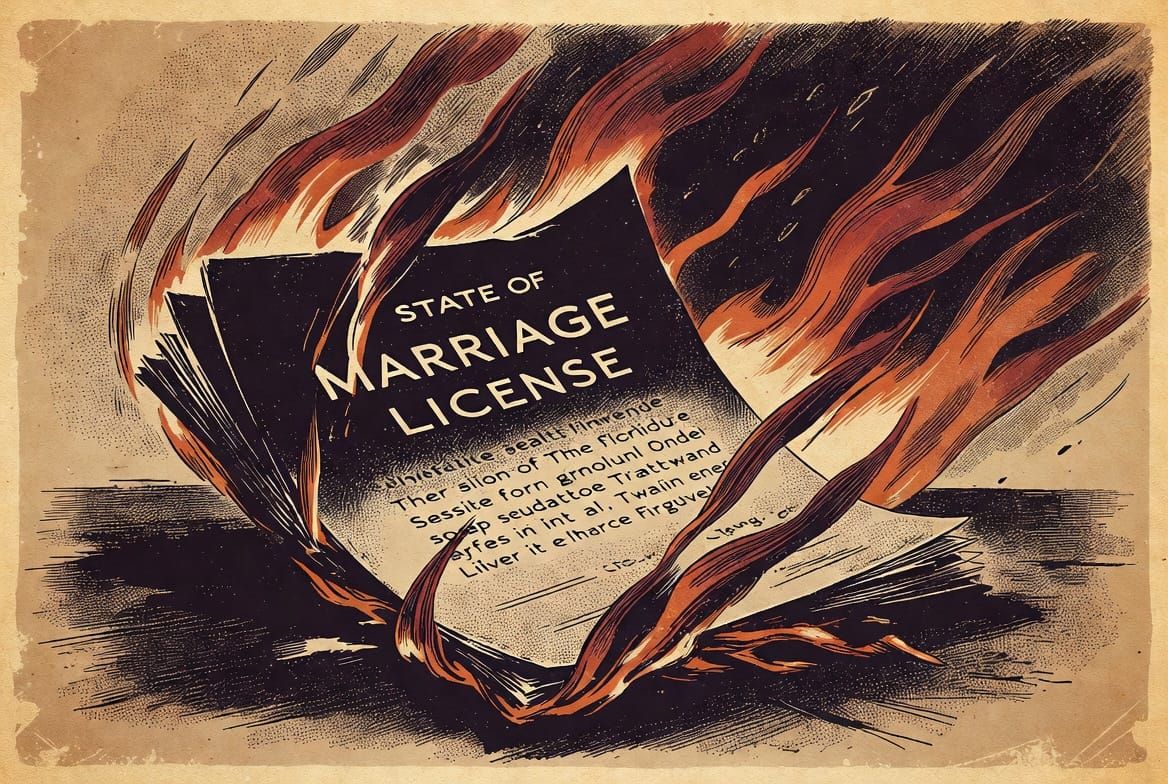
A Modest Suggestion: Burn the Marriage License and Replace it with a Contract

I am one person with a blog with some lofty ideas about freedom, fairness, and fealty, not a legislator or a policy institute. What follows is a framework, every element already present somewhere in contract law, business law, or the legal systems of other developed nations. The only thing unusual about any of it is that none of our "based" legislators have had the balls to put it to a vote on a state legislature's floor.

Oklahoma, you have never given one single fuck. Maybe you should be the first.

1. Kill the word "marriage" at the state level entirely.

The state has no business in sacraments, and religious institutions have no business in contract law. Replace civil marriage with a domestic partnership contract. Churches, mosques, synagogues, and backyard ceremonies can call it whatever they want. The state calls it what it is: a legal agreement between two adults governing shared finances, property, liability, and (if applicable) the raising of children. This is not a radical position. It's the honest description of what a marriage license already is.

2. Mandatory financial disclosure with a cooling-off period.

Before any domestic partnership contract is executed, both parties file a complete financial disclosure: assets, debts, income, credit score, pending litigation, child support obligations. Both parties must sign an acknowledgment of the other's disclosure. Then a 30-day cooling-off period before the contract can be filed. This is less onerous than what's required to buy a house. The fact that we demand more transparency for a $300K mortgage than for a lifelong financial merger should embarrass every legislature in the country.

3. Pre-existing debt stays with the person who brought it.

Default rule, not optional. Debt incurred before the partnership remains the sole obligation of the person who incurred it. Period. If one partner wants to voluntarily help pay down the other's student loans, wonderful. But the creditors and the courts have no claim on the other partner's assets for pre-partnership debt.

4. Tiered partnership structures with different default rules.

Not every partnership needs the same legal architecture. Offer three tiers:

  • Cohabitation agreement: shared residence, shared household expenses, no asset merger, no presumption of financial obligation beyond the lease. Dissolution is a move-out, not a divorce.
  • Domestic partnership: shared financial life with jointly defined terms. Partners choose at formation which assets and income streams are shared and which remain separate.
  • Co-parenting contract: can exist independently of or alongside either of the above. Governs custody schedules, financial obligations to the children (pegged to actual documented costs, not a percentage of income), educational decisions, medical decisions, and relocation restrictions. This contract requires proof of paternity and survives the dissolution of any romantic arrangement because the children's stability is the entire point.

5. Exit terms defined at formation, not at dissolution.

This is the big one. Every domestic partnership contract must include dissolution terms agreed upon and signed at formation. Division of jointly held assets. Custody arrangements if children exist. Duration and conditions of any support payments. What triggers dissolution and what the process looks like. Essentially, a prenup is no longer optional or stigmatized. It is the contract. There is no partnership without it.

6. Child support tied to actual costs, with receipts.

Child support payments are calculated based on the documented actual costs of raising the child: housing, food, clothing, medical, education, childcare. Not a percentage of the higher earner's income. Knocking up a famous singer or "having your birth control fail" with an NBA player is no longer a windfall. Payments are made into a custodial account with quarterly expense reporting. Both parents can see where the money goes. If the child's actual needs cost $2,500/month, the non-custodial parent's income being $80K or $800K is irrelevant to the calculation. The obligation is to the child's needs, not to the other parent's standard of living.

7. Alimony/palimony has a hard sunset.

Support payments to a former partner (as distinct from child support) exist only under specific conditions: one partner left the workforce at the mutual agreement of both partners (documented in the partnership contract), and needs transitional support to re-enter. Duration is capped: two years for partnerships under ten years, five years maximum for partnerships over ten. The payments decrease on a scheduled ramp-down. After the sunset, the obligation ends. Permanently. "I got used to a certain lifestyle" is not a legal argument. That's a you problem.

8. Default shared custody unless proven otherwise.

50/50 custody is the presumption. Deviation requires documented evidence of abuse, neglect, or incapacity, not allegations, not preferences, or"the children are more bonded with me." The parent seeking to deviate from 50/50 bears the burden of proof. This removes the single most powerful weapon in the current divorce ecosystem: using custody as leverage for financial extraction.

9. No-fault dissolution, mandatory mediation before litigation.

Either party can dissolve the partnership at any time for any reason. No-fault only. The dissolution follows the exit terms defined in the original contract. If there is a dispute about interpretation, the first step is mandatory mediation (capped cost, capped duration). Litigation is available only after mediation fails. This starves the divorce-industrial complex of the prolonged, adversarial, billable-hour warfare that currently bankrupts families while enriching attorneys.

The Objections (Let me tell you up front, you're wrong)

I can already hear the keyboards clacking. Let's get through these.

"This is unromantic."

Correct. A contract is not a romance. A contract has never been a romance.

The fact that Americans have spent the last century and a half draping civil marriage in the language of romance doesn't change what it is: a legal and financial agreement between two adults, enforceable by the state. Your romance lives in your home, your bedroom, or in the back of your minivan if you're nasty.

None of that belongs in a legal document, and putting it there has not made marriages more romantic. It has made divorces more vicious because people who signed a love letter are psychologically unprepared to negotiate the terms of a business dissolution.

You want romance? Write her a love letter. Buy him a watch or make his childhood favorite recipe. Renew your vows every decade in a church full of people who have watched your family grow. But don't confuse the filing you do at the county clerk's office with any of that.

"Prenups already exist."

They do. And they're stigmatized to the point of uselessness for most couples. Raising the subject of a prenup in a new engagement is treated as an act of hostility, a declaration that you expect the marriage to fail. (Dave Ramsey himself has said it's "practically planning a divorce.") The emotional fallout of even suggesting one has killed engagements outright.

Beyond the stigma, prenups are expensive to draft properly, requiring separate attorneys for each party if you want it to hold up. And "hold up" is the operative concern, because judges throw them out. Regularly. For reasons ranging from inadequate disclosure to one party feeling "pressured" at the time of signing. A prenup is a patch you apply at your own expense, with no guarantee it'll survive contact with the same court system it was designed to protect you from.

Making the partnership contract itself contain the dissolution terms removes the stigma entirely.

"This will make it too easy to leave."

Good.

No, seriously. Good. If the only thing keeping someone in your household is the financial devastation of leaving, you don't have a partner. You have a hostage. And the person holding that hostage, whether they admit it or not, is relying on the state to maintain a coercive arrangement that they could not sustain on their own merits.

If your partnership is strong, fair, and mutually fulfilling, an easy exit costs you nothing because neither party wants to take it. If your partnership is miserable, abusive, or dead, an easy exit is the only humane option for everyone involved, including the children who are currently growing up in households held together by financial fear and simmering contempt.

Before someone points out that I just spent a section explaining how divorce damages children: yes, it does. But the research is clear that what destroys children is prolonged instability and parental conflict, not having separate abodes. The current system maximizes the damaging aspects, dragging dissolution out for months or years, rewards adversarial behavior, and uses the children as leverage at every stage.

The argument that making divorce easier will cause more divorce is an argument for trapping people in bad marriages. Say that out loud in a room full of adults and see how it sounds.

"What about stay-at-home parents?"

The co-parenting contract and the domestic partnership contract both address this directly and with more precision than the current system offers. Under this framework, a partner who leaves the workforce does so under documented, mutually agreed-upon terms recorded in the contract at the time of the decision. The duration, the financial implications, and the support obligations if the partnership dissolves are all defined in advance, while both parties are still cooperative and clear-headed.

Compare this to the current system, where "he said he wanted me to stay home" is the foundation of a support claim that a judge may or may not honor depending on jurisdiction, judicial temperament, and the quality of legal representation each party can afford. The stay-at-home parent under the current system has less protection, not more, because nothing was documented and everything is subject to interpretation after the fact, when both parties are at their worst.

A woman (or man) who sacrifices career advancement to raise children deserves real, enforceable, clearly defined protection.

"The government will never do this."

Probably true. The divorce industry is a multi-billion-dollar sector. Attorneys, custody evaluators, mediators, therapists, parenting coordinators, and every other professional sustained by the current dissolution process are not going to advocate for reforms that shrink their client base.

This proposal is barely a hope, one most of us don't dare to breath aloud. I don't expect any state legislature to take it up tomorrow (though, Oklahoma, I still believe in you). This is merely a description of what fairness would look like if the people in charge cared about fairness.

Won't Someone Think of the (future) Children?

We can do better than this. We owe it to the men and women who still want to build families, who are willing to commit to another person for decades if the terms are honest and the system is fair. These are not cynics. These're realists who watched their parents, their friends, their siblings, and their coworkers get destroyed by an institution that promised them tax cuts and respectability, but gave them only destruction.

Give these fertile young folks a real contract. Give them transparent terms and a system that protects both parties at formation and at dissolution, that keeps the state out of the sacrament and the church out of the contract, and treats children as people to be protected instead of assets to be leveraged.

Give them something worth signing, and they will. I promise. They want to. Can't you hear them crying out? For families, children, a legacy, and love? They want it so much, but know the consequences of even a slight misstep will be life-destroying.

Maybe Dave Ramsey has his head far enough up his rectum to tell these kids to take that chance, but I refuse.

Right now, the only rational response to "Will you marry me?" is "Under what terms?" And until the system can answer that question honestly, don't be surprised when fewer and fewer people bother to ask it at all.

Subscribe to my newsletter

Subscribe to get the latest articles and news

Member discussion