10 min read

Die Mad About AI

On AI accusations, watermarks, and the people too dumb to see who benefits

Die Mad About AI

A few years ago, the question of whether AI was a good thing was worth having. Even more worthy of discussion was whether AI output (specifically the creative/artistic kind) was any good. But it's 2026 now, and both of those questions are settled. No, AI creative output isn't and can't be as good as human-made content, and AI companies (with all their positive and negative effects) aren't going anywhere. They will only grow. That's it. That's all.

Now my opinions on AI center around the people who spend the most time talking about it, and those opinions have gone from mild distaste to full-on irritation. In short, I can't stand these fuckers.

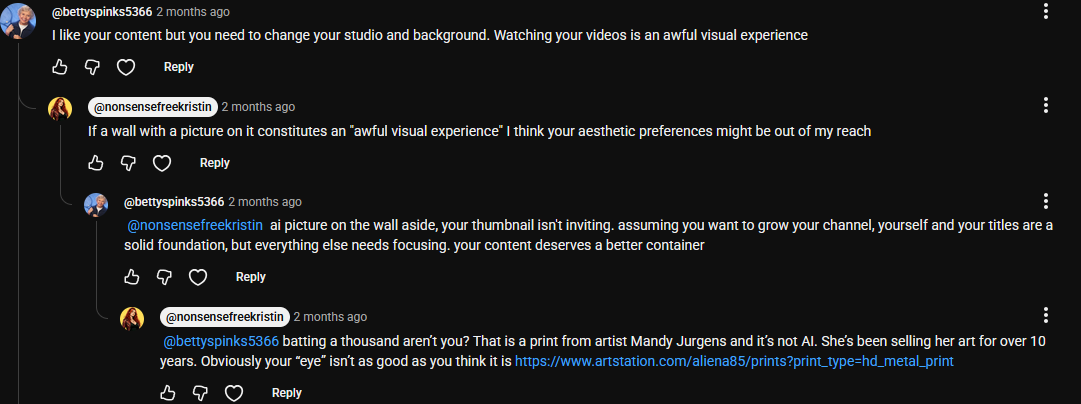
A few months ago, a commenter on one of my YouTube videos accused the painting behind me of being AI-generated. First of all, why would you say that? What does that have to do with the video you just watched? And second, you're wrong. Strange how he didn't have a reply when I dropped the link to the artist's website.
Somebody got real quiet

If this seems like a one-off to you, it isn't. This is the caliber of person now policing the internet for AI usage. This man couldn't tell the difference between a print of an oil painting and DALL-E output, and his entire investigative methodology consisted of squinting at a screen and deciding it looked suspicious, which was apparently all the evidence he needed to appoint himself auditor of my decorating skills.

I've also had multiple comments on my videos over the years accuse my scripts of being AI. Which is weird, because it's only in the last month I started using scripts AT ALL. Since 2019, all of my videos were contemporaneous. I'd sit down with bullet points, talk, and that's the whole production. It's also why video editing took so damn long. Many takes, much stuttering, too much swearing. Dog barking. Yet still there were accusations of AI "scripts."

Well, now I am using scripts, the comments have tripled, and hear me when I tell you I have no patience for them.
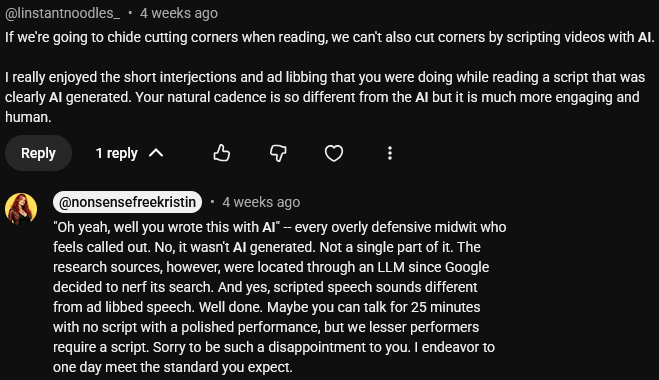
Weird how it's never the people who agree with my video that make these comments

You'll notice my responses are never short of snippy and that's intentional. It's not a loss of bearing or temper. It's a purposeful expression of disdain.

These accusers are illiterate, and I mean that precisely. They don't remember what text sounded like before 2014, before the internet flattened everyone's prose into the same algorithmic paste. I do remember, because I've been reading and writing professionally for a very long time, and I'm done pretending these accusations deserve a measured response.

Finally! A "Watermark" to Catch the Cheaters!

What brought all this up again in my personal list of grievances was the explosion of anger at Anthropic's announcement that all Claude models launched on or after August 2 now embed invisible watermarks in generated text. The watermarks are applied globally, across every product surface and cloud partner, worldwide. Google has already implemented similar measures, all to comply with Article 50 of the EU AI Act, which requires AI providers to include machine-readable markings in generated content.

Though right now the news is all about Anthropic, because they have by far the best models, I imagine that within a year, there won't be a major language model whose output doesn't carry a machine-readable signal that says "this person used AI."

Despite this objectively terrible news (Why is the EU allowed to regulate American companies, for instance?), Twitter was full of idiot indie authors dancing with glee that, at last, those AI slop authors would be brought to heel. Finally, we will definitively know who is a real author and who isn't!

Except we won't. Anthropic itself acknowledges that content may trigger a watermark even if Claude was used solely to proofread, format, or translate human-written copy.

If you'll allow me to put my tinfoil hat on for a minute here, I strongly suspect it will also be used to further fuck the common man.

Earlier this year, I received a copyright demand letter from Higbee & Associates, a law firm that partners with PicRights to mass-scan the internet for unlicensed Associated Press images and send demand letters by the thousands. They wanted $1,250 for a single AP image on a blog post that had received twenty-seven total views in its entire history. The page had no ads, no products for sale, and generated zero revenue. It was an editorial post on my editing business blog about writing memoirs.

This is an entire industry. These firms know you don't know copyright law. They know you don't have the money to hire an attorney. And they know the demand letter, printed on firm letterhead with statutory damage figures and the phrase "willful infringement," is enough to scare most people into paying whatever is demanded of them, because the cost of fighting exceeds the cost of folding. That's their whole business model, and it's built on the assumption that people at the bottom of the economic ladder have no access to the legal expertise required to push back.

Using Claude, I drafted response correspondence that was legally coherent, factual, and professionally formatted. I established the editorial nature of the use, the negligible traffic, the absence of any commercial benefit, and the prompt removal of the image. After one final threat, "We recommend you retain counsel," the firm backed off. I haven't heard from them since, and I didn't pay a penny.

Without AI, my choices would have been to hire an IP attorney at $200 to $300 an hour, which I couldn't justify for a $1,250 dispute, or to pay money I didn't owe to people who were counting on my inability to fight back.

I also have a family member currently being sued by a major corporation for debt. Yes, I know, not paying your debts is bad. The lawsuit is justified. BUT, they can't afford a lawyer, so they're using AI to draft responses to summons and discovery orders, and the filings are well-formatted, cite relevant statutes, and follow proper procedure. Without AI, their only options would have been to hire an attorney they can't pay or accept a default judgment, which is the reality for millions of Americans and has been for decades.

The legal system was built so that if you can't afford representation, you lose. AI changed that equation for people who are willing to put in the work to learn the process, and it changed it in a way that no other tool in the history has managed to do.

The people cheering about AI watermarks and detection tools have apparently never needed to use AI for anything more serious than catching cheaters in their fairy smut writing circles. Their entire frame of reference for AI-related controversy is BookTok drama and self-published romance beef, and they genuinely believe that covers the scope of what these tools are being used for.

Will courts start dismissing or deprioritizing pro se filings because they carry an AI watermark? That's hypothetical for now, but the infrastructure to make it possible is being assembled as you read this, and the people who should be alarmed are instead gloating online about how "cheaters get wrecked." The watermark becomes a class signal that gives every institutional player in the process a new reason to screw us over.

Yeah, I Use AI Music. What of It?

I use AI-generated music for my YouTube intro and outro. There's plenty of stock music I can get for free, and even more I can pay for to use as background or prominently in my title card. But I don't.

I use Suno, and I do this for one very specific reason: it's the only way to guarantee that a business deal I had no part in won't retroactively destroy my content.

In June 2026, YouTuber Tom "Syndicate" Cassell disclosed that nearly 3,000 of his videos had been hit with copyright claims after a new rights holder acquired the music he'd been using as his outro for eight years.

A copyright claim means that someone else gets all the ad revenue for those videos. Videos he made and rightly owns.

He had the rights to the song he used and had been using it legally for the entire run of his channel. Then someone else bought those rights and immediately started claiming every video that contained the track, and eight years of content was demonetized overnight. YouTube's content management system identified the track as "Cloud 9 (From Cloud 9/Music from the TV Movie)," and the claimants listed included Walt Disney Music Company and UMPG Publishing, which tells you exactly the scale of entity that a solo creator is supposed to fight when this happens.

This is the system the AI purists want you to stay inside of. Pay for human-created music, accept the ongoing legal risk that your revenue can be retroactively stripped, and then also accept the moral judgment of people who've never built anything worth claiming.

The same logic applies to stock photography. I use Canva's AI features to adjust my thumbnails for blogs and videos because stock photo trolls operate on the same extortion model as the copyright letter mills. You use an image you believe is properly licensed, rights change hands, a law firm sends you a demand letter for thousands of dollars, and suddenly you're being charged money for having created something.

No. The answer is no.

Substack, Pangram, and the New Salem

Another recent hubbub is Substack's partnership with an AI detection tool called Pangram. Readers can now scan any post, note, or comment over 100 words and receive an estimated percentage breakdown of how much was written by a human versus AI. Substack's announcement post coined the term "Claudefishing" to describe using AI to fake human connection, which is certainly a word someone was proud of.

The tool returns an estimate, as Substack themselves acknowledge, based on a deep learning classifier trained on about a million documents. It can be wrong, and it is frequently wrong, but none of that matters because the accusation is the point. I covered this exact dynamic in my essay on Victorian propriety: to be named is to be halfway to guilty, and the naming needs nothing more than a neighbor's certainty and a room willing to believe them. Pangram is just the latest incarnation of that nonsense.

If Pangram scans one of my essays and returns a 60% human-written rating, what exactly is the appropriate response? Should I grovel? Post my drafts? Upload a timelapse of myself typing?

Dr. Sam Illingsworth gives good advice; but I will do none of it

If you believe I've produced "slop," unsubscribe and go away. You were never going to trust me anyway, and I was never writing for someone who needs a machine's interpretation of what they're reading.

I don't care that Substack implemented this. Fuck you. Anyone in my comments who writes "Yay for the watermark, anyone who uses AI is dead to me" is getting blocked. You're too dumb to be here. You have no idea what these tools will actually be used for, and you're cheering for a system that will crush the people at the bottom while the people at the top continue on their merry way.

Oh, did you think these "detection" measures would affect big corpo? That they would stop using AI and start hiring humans again? Specifically American humans? Did you think the publishing world would suddenly value your bespoke human novels and come begging to sign you?

I'd laugh at you if that wasn't so sad.

My Work Is My Work

I've already told you what I don't like about AI output. It's predictable, flat, and boring when it comes to novels, essays, video scripts... probably poetry too. But I don't like poetry so I can't speak to that.

What I do use it for, to great effect, is helping me with health, fitness, and finances—both short-term and long-term. I like that it helps me salvage rice noodles that I didn't cook quite long enough. I like that it helps me safely descale my Keurig machine with products I already have in my kitchen.

These are the things we used to use search engines for. But now search engines suck (on purpose, mind you), so here we are.

I like AI even better when it comes to distilling a thesis statement out of 38 pages of notes taken while watching 7 seasons of The Walking Dead, and then helping me outline. I like that I can upload centuries-old morality treatises and the AI can help me suss out the main points, even with highly dense works like Samuel Johnson's The Rambler essays.

I have never felt so uneducated in my life as when I tried to sit down with those. Good grief.

If you ever want to feel dumb...

But I write my own essays. And YouTube scripts. I just finished a week's worth of writing an 8000-word script on Heat. MYSELF. I construct my own arguments, take my own positions, and defend them with my name attached. I use AI for research assistance, for correspondence, and other situations where it's helpful. And I won't suffer anyone who flings mud at a tool they personally blame for their own failings. I just won't.

The system will always protect itself at your expense, and that's all this watermark business is doing. The copyright troll law firms will use AI to their benefit, as will the corporations suing individuals, and you best believe companies that buy up music rights specifically to claim other people's content will use it. And the jealous, shrieking AI purists in the indie author community will cheer every bit of it, convinced they're on the side of the angels, because they've never once had to think about what happens to people who can't afford the "real" version of anything.

Which is why I do not suffer these conversations any longer. Every person is free to live and work as they please without interference, so I will do just that. How anyone else feels about that is not my concern.

Join Us

Free subscribers get weekly essays on morality, culture, and character through fiction. Paid subscribers get everything.

Member discussion