Nolan Got Agamemnon Wrong Too (Kinda)

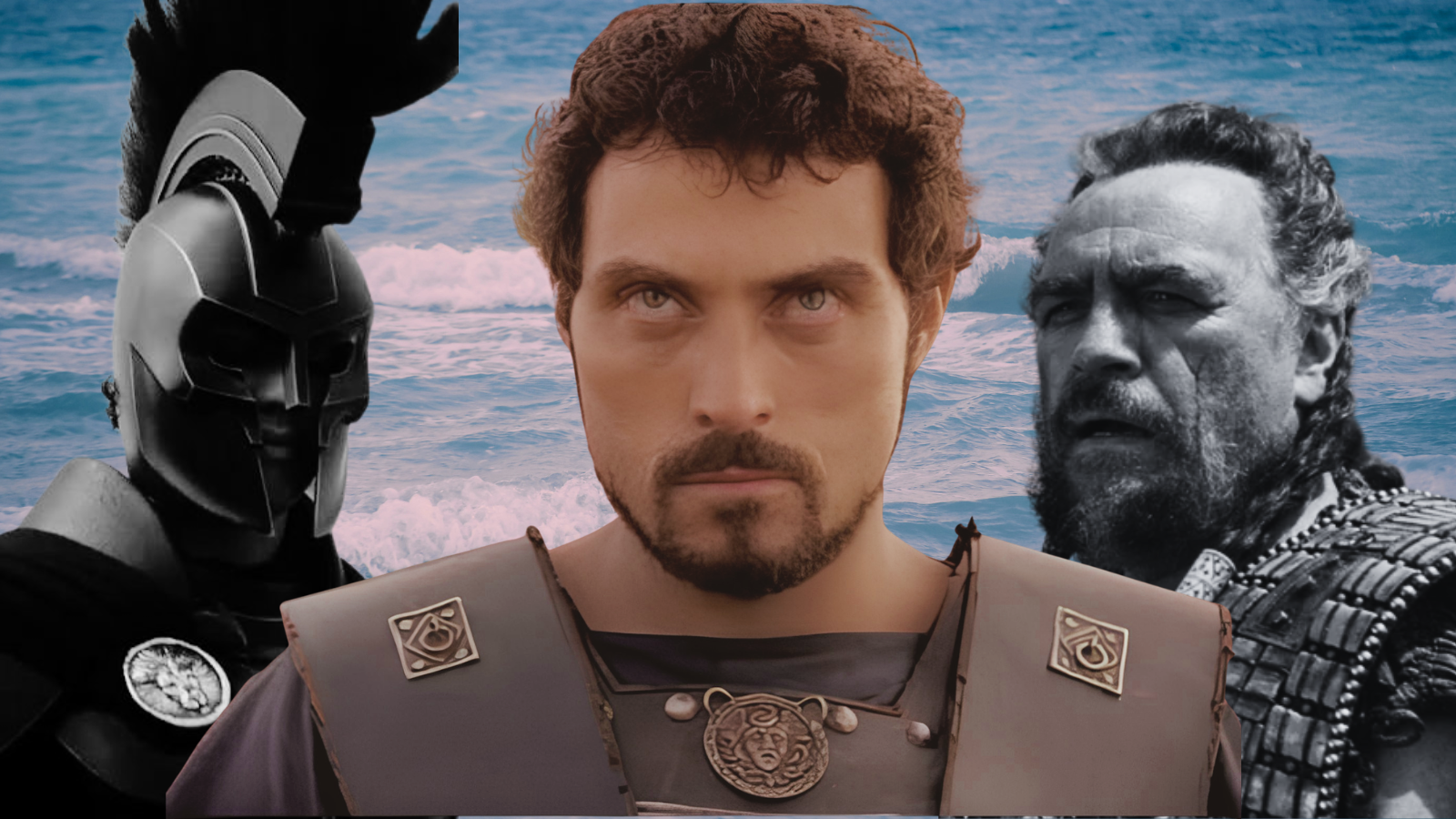
After months of speculation and mouth-frothing anger from internet movie critics and lovers of the Western canon, Christopher Nolan's The Odyssey has hit theaters, and the consensus from most viewers seems to be "It's good, but I'm still mad about black Helen of Troy. And the 5'1 manlet who once played a pregnant teen."
In addition to the comparisons against the source material, Homer's epic poem of the same name, critics have also been comparing Nolan's film to Troy (2003). You may remember that glorious, sun-baked retelling of the Iliad starring Brad Pitt's magnificent cakes. I certainly do.
Yet somehow, no one, and I mean no one, seems to remember that there was another Homer adaptation released just before Troy hit theaters. And in my own humble opinion, it was a better adaptation with bolder narrative choices, and is a better jumping-off point for people wanting to hold up a comparison point for Nolan's work.
Many years ago, I spent my afternoons watching The 4400, a series on USA Network. It was a good show, but I'll be damned if every single commercial break wasn't filled with ads for their upcoming Helen of Troy miniseries. It was to star some slender blonde with an amazing keaster (the finest ever shown on network tv, perhaps), and Rufus Sewell, the bad guy from A Knight's Tale.
I got so sick of the ads, I decided to watch the damn thing out of spite. Surely that would appease the USA Network overlords. It was only two episodes and shot in Malta on what was clearly a television budget. I had no expectations.
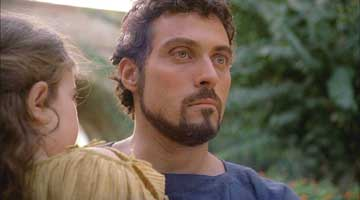
Then Rufus Sewell walked on screen as Agamemnon, and something in my brain broke in a way that has never fully healed.
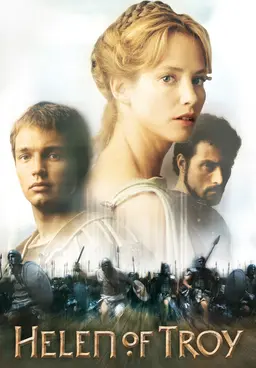
All those violent, morally gray alpha males in the dark romance books these days are trying to be what Sewell put on screen in Helen of Troy, and they all fall short. The smolder, my God.
Sewell plays Agamemnon, a man who is, by any reasonable moral accounting, one of the worst people in the world. Like in the original poem, Agamemnon kills his own daughter, Iphigenia, to win favor from the gods and sail his fleet to Troy successfully. He also wages the decade-long Trojan war out of an obsession with Helen (a departure from most other adaptations). His final act in the story is the sexual assault of the woman he's been fixated on since the first scene. And Sewell is so handsome, so commanding, so entirely in control of every frame he occupies, that you understand on a gut level exactly how men like this accumulate power. You watch him and you get it. People followed this guy willingly. Even after they watched him murder his own kid. That's the whole goddamn problem, and the miniseries knows it.
I want to talk about a version of Homer that very few saw and fewer seem to remember, that you can't stream or buy digitally anywhere in the United States as of this writing, and that understood something about Agamemnon that neither Nolan nor the $200 million Troy (2004) was willing to explore.
Three Agamemnons
Every adaptation of the Trojan War has to answer a question about Agamemnon, even if it answers by refusing to engage. The question is this: the myth says he sacrificed his daughter Iphigenia to Artemis in exchange for favorable winds to sail to Troy. What do you do with that?
Your answer reveals everything about the moral seriousness of your story.
Troy (2004) doesn't answer at all, which makes a kind of sense. It was more of a spectacle movie. Brian Cox plays Agamemnon as a political bully who wants to conquer everything in front of him and uses Helen's abduction as a convenient excuse. Cox is doing his over-the-top thing, and it's fun to watch, but the character has exactly one gear: I want power, give me power. There's no Iphigenia. And given Cox's age (57 at the time), she would have been a grown woman if she had appeared. There's no sacrifice at all. This is the comfortable version. Agamemnon is bad because he's greedy, and the audience is freed to focus entirely on the sadness of Hector's death at Achilles's hands.
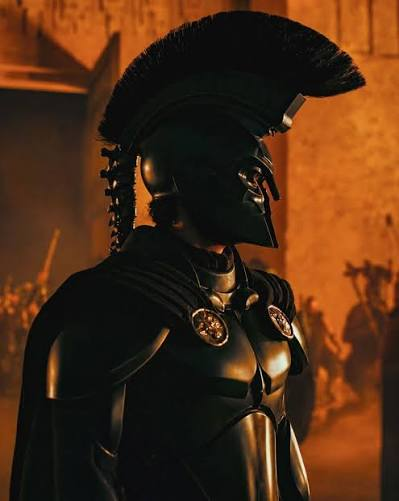
Nolan actually does include it, but only as a glancing blow. In The Odyssey, Agamemnon is played by Benny Safdie, and Nolan made the choice of hiding Safdie's face behind black armor for most of his screen time. The sacrifice appears as a single flashback, a shot of Agamemnon carrying a small child while his wife, Clytemnestra, screams. Later, Clytemnestra kills him for it. Nolan acknowledges the sacrifice, codes it as monstrous, and moves on because his story belongs to Odysseus. It's only in the movie as context for Clytemnestra's revenge rather than as a moral question. It doesn't ask if Agamemnon's sacrifice was a patriotic or heroic act. After all, the gods are real in this film; and they were clear that if he wanted to sail his fleet to Troy... he would have to throw the baby out with the bath water.
The 2003 miniseries doesn't let us off that easy. Rufus Sewell's Agamemnon sacrifices Iphigenia on screen. He lies to Clytemnestra, saying he will bring their small girl to Troy with him. His wife, of course, finds that odd. But he is her husband, and the high king of Mycenae. She cannot say no. Iphigenia doesn't know what's happening. She's playful, jumping up and down happily as soldiers carry her toward the altar. Toward her daddy, who has promised to take her on a trip. She throws herself into her father's arms so he can swing her around before they go. She trusts him completely.
And he kills her.
The second the life leaves her little body, all the ships sails fill with wind. The god's favor (Poseidon in this adaptation) has been secured, something Agamemnon desperately needed. He had to get to Helen. Had to teach her a lesson. And now he's done the unthinkable rather than setting his obsession to the side. And the miniseries follows that dark thread all the way down to damnation.
The First Domino
In Homer, and in most adaptations, Agamemnon's motivation for the war is political. Helen's abduction gives him a pretext to consolidate Greek power and sack a wealthy city. His personal obsessions, to the extent he has them, involve glory and dominance in the abstract. Helen, her extraordinary beauty, and the status of the man who possesses it, are all mere justifications.
The 2003 miniseries changes this, and the change is the whole ballgame.
In this version, Agamemnon arrives in Sparta to claim Clytemnestra as his bride and immediately fixates on her sister, Helen. He wanted Helen but had to follow through with the marriage to her sister instead. The series establishes this early and lets it color everything that follows, even showing a scene where Agamemnon, Menelaus, Achilles, and other men whose names escape me all sort of draw straws for her, agreeing that whoever gets her will own her completely. None of the other men will try to woo her away. So great was her beauty that the men had to swear an oath in advance not to run off with her.
Underneath all that is the small and oh-so common ugliness of sexual obsession. Even as Agamemnon swears to defend his brother's ownership over Helen, he covets her incessantly. And every instrument of power available to him, including the life of his own child, becomes a tool for getting what he wants.
This reframing turns Agamemnon from a generic conqueror into a man who uses his institutional authority to pursue a personal obsession. We've all known men like this, or known of them. The guy whose professional power and personal hunger are so entangled that you can't tell where ambition ends and predation begins. Gross, all of them. Though sometimes you don't see what they are until it's too late.
The sacrifice of Iphigenia, in this context, isn't a standalone atrocity. It's the moment where Agamemnon proves to himself and to the audience what he's willing to destroy everything to get what he wants. His child. His wife. His own men. The entitlement that allowed the first act guarantees every act that follows.
Agamemnon's Death Spiral
After Troy falls, Clytemnestra arrives at the royal palace. After walking through the leveled city and the corpses of children at the city walls, she finds her husband in the royal pool with Helen. Both of them are naked and it's pretty clear how he celebrated his victory. Agamemnon is relaxed, triumphant. Helen sits near the water and says nothing.
He got what he wanted. This was what he came for. And the ten-year war, the sacrifice of his little daughter, and tens of thousands dead on both sides–all of it was worth it to him, because he's here now, in this pool, with Helen.
Clytemnestra covers her sister with a robe and sends her away. Then she tells Agamemnon she's come for Iphigenia.
"She's not here," he says, no longer bothering to conceal his disdain for her.
"I know," Clytemnestra replies, and subdues him with a steel net and slaughters him with a trident. I doubt that choice of weapon was random on her part.
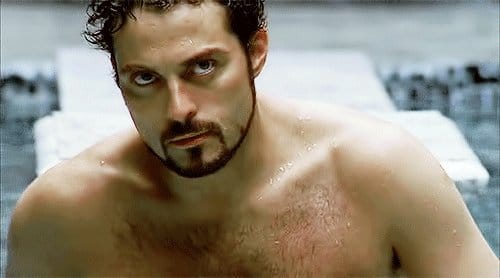
The writers made a deliberate choice to put the assault in the pool as Agamemnon's final act of evil rather than, say, the mythological taking of Cassandra as a war prize. It closes the loop the series opened when Agamemnon first looked at Helen in Sparta. The sacrifice of Iphigenia sits between those two moments, between the first look and the pool, and the series is arguing that they're all expressions of the same impulse. The wanting. The taking. The willingness to spend other people's lives to satisfy both.
The Horror of Charisma
I said at the beginning that something broke when I watched Rufus Sewell in this role, and it's important because my own reaction is part of the argument.
The Bad Boy Innoculation
Why Every Girl Needs to Fall for Magneto Before She Meets Him in Real Life
 Kristin McTiernan
Troy gave all its charisma to Achilles. Brad Pitt, golden and beautiful, moving through battle scenes like the world was built for him. That's the traditional arrangement: the hero gets the looks and the magnetism. The villain gets to be ugly or bloated or old, so you know who to root for without thinking too hard about it. Brian Cox chews up the scenery, but they didn't work too hard on his aesthetics. You're never confused about where he falls in the moral hierarchy.
The miniseries, on the other hand, put the charisma in the villain. Sewell is the most compelling person on screen in every scene he's in, and he's playing a man with no moral floor. The original Variety review in 2003 said he was "burning with passion and anger." Viewers on IMDb, even ones who criticized the rest of the miniseries, singled him out as the performance that made the whole thing worth watching. He brought an intensity that the rest of the cast couldn't match.
When the most magnetic person in your story is the worst person in your story, you're forcing the audience to confront something about themselves and about how power actually operates. We talk about evil as though it's always legible, as though bad men repel. They don't. The dangerous ones attract. They walk into rooms and people rearrange themselves.
Agamemnon kills his daughter in full view of his men and they still follow him to Troy. He's still the king. The sacrifice didn't diminish him in anyone's eyes because his authority was never rooted in goodness. It was rooted in capability, in certainty, in the willingness to do what other men couldn't stomach.
And here I am, twenty-some years later, still thinking about Rufus Sewell in that role, which is exactly the reaction the miniseries was engineering. I was supposed to be captivated. And if nothing else, the evil overlords at USA Network accomplished that mission flawlessly.
The Question
Nolan's The Odyssey is a massive technical achievement and it's earning every dollar of its box office. Troy is a perfectly decent sword-and-sandal spectacle with a great Achilles and a great Hector (Eric Bana deserved better from that decade, honestly). Both films treat Agamemnon as a problem to be contained, a bully with more firepower than is good for him.
The miniseries asked a harder question. What happens when you follow the line from a man's first desire to his first destruction to his last? What does a story look like when it refuses to let its villain off the hook at any point along that trajectory?
This (not terribly faithful) adaptation of The Iliad made it clear that your actions determine what kind of person you are. Nothing else. Not your anguish, not your heavy heart, not your claim that the gods demanded it. The 2003 Helen of Troy understood this all the way down, and Rufus Sewell made you watch a man prove it across four hours of television.
I never recovered, and I'm better for it.
My video explaining my pivot away from making writing and publishing content on YouTube dropped yesterday. If you missed it, you can watch it here
Written by

Join Us
Free subscribers get weekly essays on morality, culture, and character through fiction. Paid subscribers get everything.







Member discussion