

I started watching the new Carrie series on Prime Video a few weeks ago, much to my older sister’s surprise. “I wouldn’t think you could handle that,” she said.
I do not watch movies and shows about cruel school-age bullies. I tried to power through Welcome to the Dollhouse many years ago and barely made it 10 minutes in. Lest my hard-ass reputation take a beating, it’s not because I curl into a ball and cry. It’s because those movies infuriate me. If there’s one thing Hollywood never fumbles, it’s realistic portrayals of middle school cruelty.
Carrie is no exception and I had to watch no more than one episode per day. Even still, I looked at the lovely actress playing Carrie’s bully and said, “I’m so glad you die. And I can’t wait until you do.”

After I finished the series (it was excellent, and I liked the departures from the source material), the Netflix algorithm casually recommended I should watch Adolescence next. Sure, why not?
The limited series is just four episodes, but packs quite a wallop. Each episode is filmed in a single continuous shot, immersing you into the story as you follow a different set of people through the aftermath of a thirteen-year-old boy murdering his classmate.
I was enraptured even as I was horrified, but not at the themes of bullying. For once, I was able to sit with the story and watch the children and their horrible behavior through adult eyes instead of being transported back to my teen self. I was able to imagine myself as a parent to the little boy who killed a little girl, and I came away deeply affected. Strangely enough, I watched the last episode with a quote from Star Trek ringing through my head: “It is possible to commit no mistakes and still lose.”
Because from my perspective, the parents of the murdering child committed no mistakes. And yet they lost. All because the love they gave their son was no match for the hate he received from his peers.
A Good Boy
If you haven’t seen the show, Adolescence takes place across four episodes, each one covering a different stage of the aftermath and each one told from a different perspective. Episode 1 is the arrest. Episode 2 is the school. Episode 3 is the psychological evaluation. Episode 4 is the family.
The murdering boy, Jamie Miller (played by Owen Cooper, who is excellent and who looks young for thirteen, which is the point), is arrested for stabbing his classmate Katie to death with a kitchen knife. The problem for this sweet-looking boy, who insists the police have it wrong, is that they got this kid in 4K killing the girl on CCTV. There’s no question that he did it. The show’s interest is in why, and in who failed him along the way.
Because surely someone MUST have failed this boy. He wasn’t born bad, and he wasn’t made bad. At least not by his family.
Jamie’s father is Eddie, played by Stephen Graham, who co-created the show and is magnificent in this. Jamie’s mother is Manda. They are working class, English, and recognizably decent. Eddie has a thick Liverpudlian accent that is markedly different from the cops and the lawyers, and the class difference is visible every time he opens his mouth. He is wildly out of his depth from the first scene to the last.
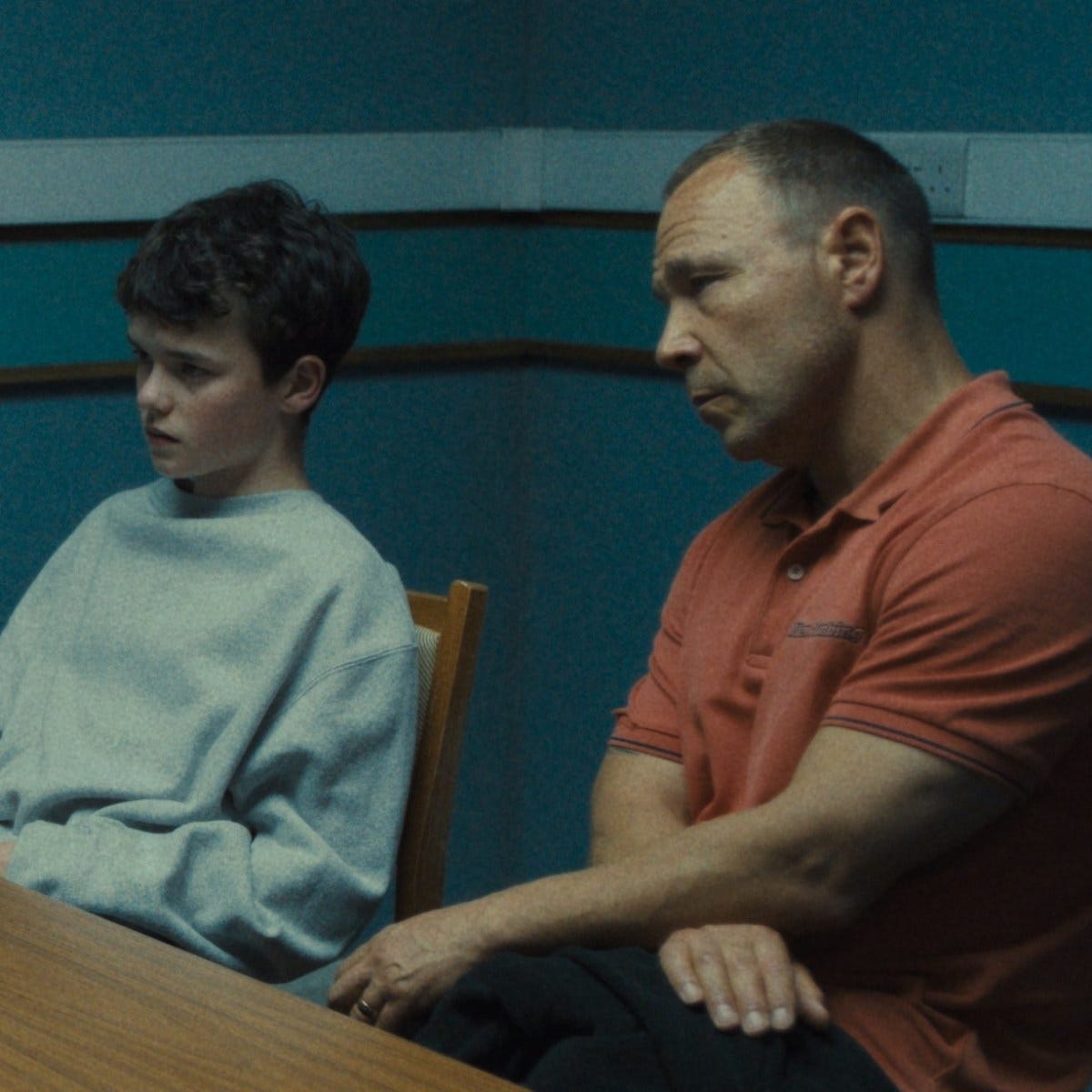
The conversation around this show has been almost entirely about misogyny and online radicalization. Andrew Tate gets mentioned by name in the show, and critics and politicians latched onto that as the takeaway: boys are being poisoned by the internet. Prime Minister Keir Starmer endorsed the show in Parliament and backed Netflix’s initiative to screen it in every secondary school in Britain as a tool for combating misogyny and online harm. He also (rather insanely) referred to it as a documentary. I think some of the morning show hosts did too. Like they forgot this was fiction, only slightly inspired by true events.
That’s all worth addressing, and I will in my next video. But it’s honestly secondary to what I think the show is actually about. Adolescence is about parents who did everything right and still lost their son, because the forces working against them were stronger than anything they knew how to fight.
Eddie is a good dad. Unambiguously. We don’t often see good, strong fathers on TV these days, but Eddie is one. Even if his own father was not. He grew up in a violent house, and he decided he would never do that to his children, and he kept that promise. He looked at what damaged him as a child, and he made sure he didn’t do it. That’s what every therapist and insufferable trauma-informed TikTok influencer tells you to do. Identify the wound. Don’t repeat it. Be better.
He was better. And it wasn’t enough. Because the threat to Jamie didn’t come from his father’s fists. It came from two places Eddie couldn’t reach: the school and the phone.
Feral, Vicious Children
Episode 2 is set in Jamie’s school, and that was the one that hit me the hardest. The camera follows the detective investigating the murder (played by Ashley Walters), who I will call Captain Creatine because this man takes arm day seriously. He goes to the school trying to piece together what happened. Why did Jamie kill this girl he barely knew? And where did he get the knife? What he finds is chaos. Not organized chaos, like gangs or racial tensions or any of the things you might find in the worst schools in the US. Just raw, unfocused aggression and cruelty from every direction.
As it happens, I went to school in Britain in a working class neighborhood. And holy shit, am I glad it was nothing like Jamie’s school. One boy shoves another into a column and demands one pound fifty. The passing teacher’s only intervention is to tell the boy he doesn’t need the money because he’s on “free dinners.” Violently demanding lunch money from passing classmates is apparently acceptable. Or at least not worth raising your voice over. There are male teachers aplenty in this school, but they get no more respect or obedience than the ladies. In the classroom, the children jeer at one another, the hierarchy instantly clear to the visiting detectives, as is the uselessness of the staff.
Jade, Katie’s best friend (and the only friend Katie had, we learn), is a tightly-coiled snake of a girl, ready to strike at anyone who gets too close. And she does, right in front of teachers and police, she sucker punches one of Jamie’s friends during a fire drill. The teachers yell at her to stop, but nothing happens. The only reason they were outside at all is because some little shit pulled the fire alarm for fun, and all the other little shits gather around to film Jade’s unprovoked and vicious assault on their phones. Jade is hostile to the police even though they’re trying to build a case for her murdered best friend, because she hates cops, because that’s the world she comes from. She has one teacher she trusts and she still won’t talk to her because she’s afraid of “another shrink.” When she finally breaks, she says about Katie, “She was the only one who thought I was okay. I don’t have anyone else.” All these kids are fighting for their life on a daily basis, and they laugh at the idea that any adult can or would do anything to make it stop.
The adults in this school have been stripped of every tool that might let them intervene. They have no authority to enforce real consequences. They can’t protect the kids being targeted and they can’t restrain the kids doing the targeting. Every interaction between these children is governed by a hierarchy the adults can’t see and can’t access, where the only opinions that carry weight belong to other thirteen-year-olds, and where the approval of your peers is the only thing that matters and losing it means you are nothing.
Jamie lived inside this hierarchy for eight hours a day, five days a week, and when he came home, there was no reprieve, thanks to his phone and the computer in his bedroom, where he continued to absorb the same messages and the same cruelty long after his parents thought he was asleep. Jamie was not a cowardly boy, or even a particularly weak one. But he was at the bottom of the pecking order, so his fighting back didn’t help. If anything, it made things worse. And if your school days were spent at or near the bottom of the social ladder, you know the truth of that.
Manda knew Jamie was up late on the computer. She mentions it in Episode 4, in a quiet conversation with Eddie where you can hear her replaying every warning sign she dismissed. She told herself it was just how teenagers are. That’s what every parent tells themselves when they see something they don’t have a framework for.
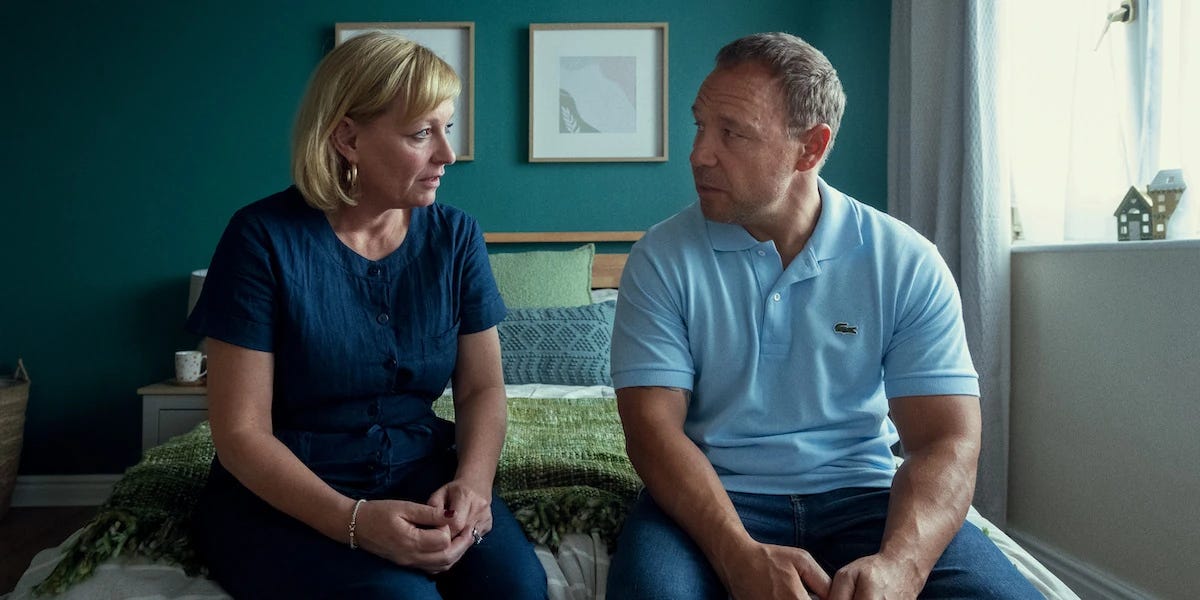
Every generation of parents defines good parenting as the opposite of whatever their parents did wrong. That’s how we all got stuck with this plague of “gentle parenting” and tiger moms, brought to you by parents who were raised as “latch-key kids” or whose boomer parents beat them with a wooden spoon.
But correcting one problem left Eddie completely unprepared for a different problem, one he’d never experienced and never saw coming, and by the time the new problem was even visible to him, his son was already in jail for killing a girl who had humiliated him.
When the Dam Breaks
Another thing about Eddie is that, despite being beat as a child, he never cared if people laughed at him. He and his wife tell their daughter a story of how in middle school, Eddie slapped on a pink wig at a school dance and was the only one on the dance floor, not caring that he looked ridiculous. He made Manda laugh, and that was what started the spark between them. He talked to girls. He wasn’t afraid of them. Nor did he view their rejection as a life-ending humiliation. In short, he was a socially competent, well-adjusted boy. And that’s why he married his childhood sweetheart and made a good life and a good family.
Except that his son inherited none of that. Bad at girls, thus laughed at by his classmates. Bad at sports, which made his father ashamed. Good at drawing, though. Yet that skill never seemed to matter. Not to anyone.
Episode 3 is the psychological evaluation, seven months after the arrest. This is the episode that got the most play on social media, and everyone had a different take on what it all meant.
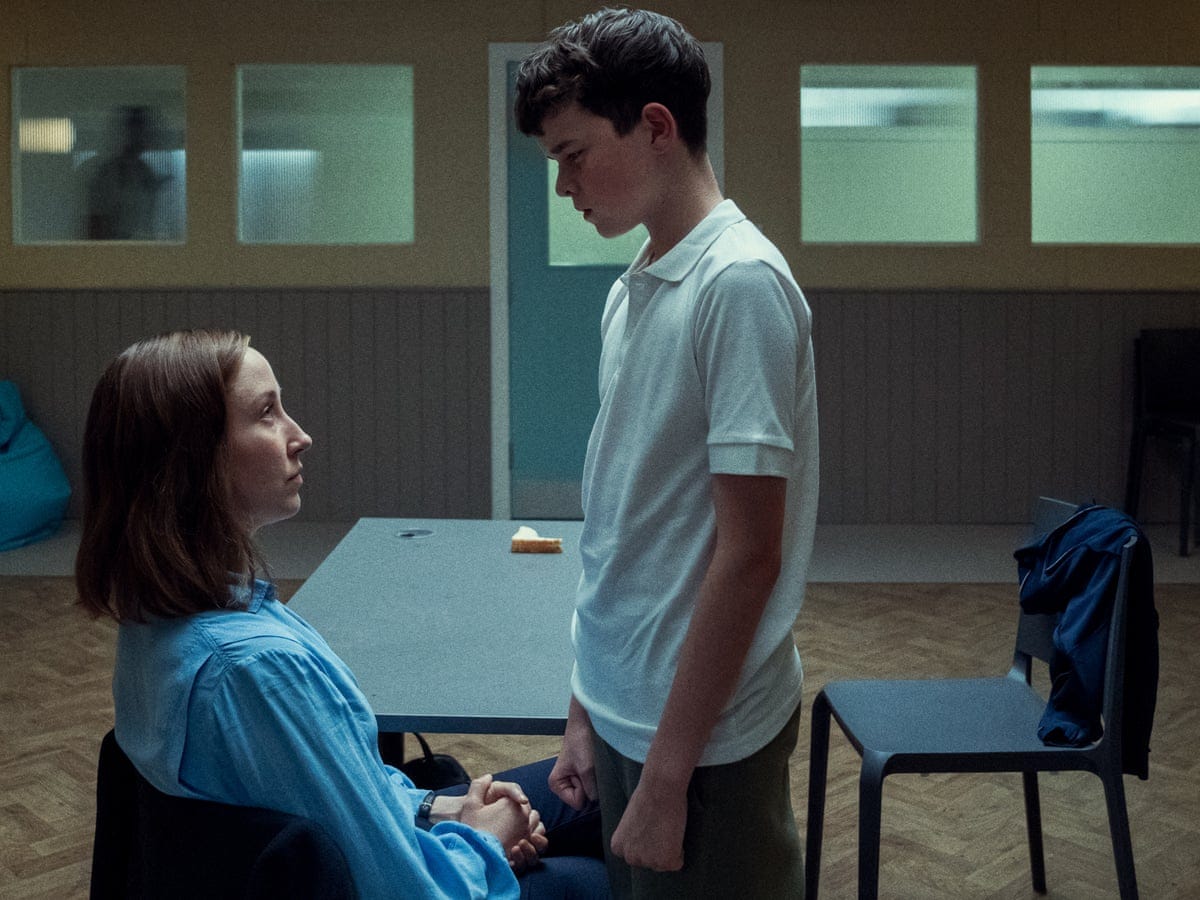
Jamie meets with a clinical psychologist played by Erin Doherty, and the episode is a chess match. The psychologist is good at her job. She brings Jamie hot chocolate the way he likes it, compliments him, laughs at his jokes, slowly circles his ideas about men and women and what he thinks he deserves. Jamie can feel that she’s steering the conversation and he pushes back. It’s not hard to see where his sore spots are. His father, for one. He won’t tolerate any aspersions cast on Eddie, not even the hint of one. And girls, for another. Specifically, what girls think of him. He has furious, aggressive outbursts multiple times, always in anger that he is being judged. By his father, by the girls at school. Even by the psychiatrist herself. One of his fits of rage comes after he says he’s ugly, as many children do, and she doesn’t contradict him. “You’re supposed to tell me I’m not. Why don’t you act normal?” He has no ability to self-soothe and responds with aggression and insults. There’s no letting anything roll off his back, and having seen his school, you can understand why. His every behavior makes sense based on what you saw of his daily life at school, and the ceaseless mocking of him. Not only for who he is now, but who he will always be.
The function of the “It Gets Better” campaign was to help school kids understand that your life won’t always be like this. And you shouldn’t kill yourself because high school sucks. For the record, you shouldn’t kill anyone else either. But Jamie did, largely because he couldn’t see any hope that the future would contain less torment than his present reality did. The funny thing about the It Gets Better Project is that it’s for LGBT kids. It’s not for the straights. The majority.
I suppose if you made a nonprofit initiative dedicated to the idea that middle school and high school are fucking torturous humiliation rituals for EVERYONE and that you have to white-knuckle your way to adulthood when they can’t do this shit to you anymore… I don’t know, maybe that would be bad PR for the education system.
It Doesn’t Always Start in the Home
The fourth and final episode takes place in Jamie’s home, with his family trying to get on as best they can. Though Jamie’s room is still untouched. It’s the quietest and most devastating episode. You can see Eddie and Manda love each other. They have an active sex life, which I have been reliably told by Twitter malcontents is rare in over-40 couples with kids. Their daughter is a good girl who tries to look after her parents in their fragile state, just as they look after her. It’s a good family, even in the midst of a walking nightmare.
Eddie blames himself, questioning if any part of who his son became is his fault. “I just wanted to be better,” he tells Manda. “But am I?”
The answer to that question is yes and no at the same time. Yes, Eddie is a better father than his father was. He is gentler, more present, more loving. He broke the cycle of violence in his home, even as the anger from his past remained within him. But no, it wasn’t enough, because the cycle he broke was the one that had already ended. The threat he prepared for never arrived. The threat that did arrive came through channels he didn’t know existed, in a language he didn’t speak, inside institutions he had no power over, and it built up inside his son for years while Eddie was right there in the house, loving him, doing everything right, and seeing nothing.
The show ends with Eddie standing in Jamie’s bedroom, alone. The room is still decorated exactly as it was before. Linens still on the bed. But his boy is gone. He cries and says, “I’m sorry son. I should have done better.”
Stephen Graham, who co-created the show, said in an interview that they could have made a drama about gangs and knife crime, or about a kid whose mother is an alcoholic or whose father is a violent abuser. They deliberately chose good parents, because the harder question, the one that stays with you after the credits, is whether good parenting is even sufficient anymore when the forces working against your child have more access to him than you do.
It’s normal and age-appropriate for teens to value their peers over their parents. It’s an important part of them finding independence, getting ready for adulthood. Finding their place in their peer group is all that matters, and when they’re excluded or made into a joke, it’s like death. It always has been. But there used to be a reprieve. If school was a bad place for you, it didn’t follow you home. It didn’t haunt you while you hung out with your friends on weekends. That was the world Eddie and Manda were prepared to deal with.
And it was an entirely different world than the one Jamie lived in.
It is possible to commit no mistakes and still lose.
The love and safety Eddie gave his son was real, but altogether insufficient against the institution he was required by law to send his child to, and the Lord of the Flies hierarchy within, to say nothing of the online world from which there was no escape.
In my youth, there used to be a PSA that came on just before the 10 o’clock news: “It’s 10 o’clock. Do you know where your children are?” Now such things are unnecessary. Yes, the parents of the world know exactly where their children are.
In their room. On the phone. And that’s better than running the streets, right?
Right?