

Hollywood would really like you to leave your family.
If you’ve watched more than a handful of films or major shows in the past thirty years, you know the formula. A wife walks out on a perfectly decent husband so she can go find herself in Italy (looking at you, Eat Pray Love). There’s also The Banger Sisters model where she doesn’t leave, but is shown to have diminished herself by being a wife and mother. If she DID leave, it would be good and right because she’s amazing and her dismissive husband and ungrateful kids never appreciated her.
Men are also encouraged to forgo or abandon their families, but with a twist. Men are shamed for their long absences or outright abandoning of family, even as the film subtly tells you it was worth it by virtue of their accomplishments: Heat, The Insider, Interstellar, First Man. The message for men is that yes, having children and a woman to adore you is important, but THEY are not important. Your mission is.
We’re supposed to root for these people. And plenty of us do, because movies are made for entertainment. But even as we’re entertained by these movies, many of us have noticed the pattern. We’re all being told that everything would just be so much better if we weren’t trapped in our stupid little lives. With our stupid little job. And that stupid partner who is just so annoying. And the kids… we love our kids. But wouldn’t it be better if they just weren’t there?
It’s a nasty message, having gotten louder in recent years as childless millennials have taken over writer’s rooms.
But the message isn’t universal. Many times, the message getting pumped out has holes in it. And every so often, usually right at the moment that’s supposed to matter most, they tell on themselves.
The writers for these shows and movies—the ones who actually live these rich glamorous lives and Hollywood insiders—are showing us perhaps more than they intended in some of their work. Yes, we all see the message these writers are putting out. But if they’re so pleased with the decisions they’ve made and the life they’re advocating for, they’re making some interesting choices in their stories.
Suburban Family Life: The Ultimate Nightmare?
American Beauty came out to massive acclaim in 1999, and it’s an interesting case to behold. The film is directed by Sam Mendes, who has made a bit of a habit of making movies that spit on suburban family life (Revolutionary Road being the most egregious example).
And on the surface, American Beauty seems to fit Mendes’s pattern. Lester Burnham (played by Kevin Spacey) hates his job and can barely stand to be in the same room as his wife, Carolyn (played by Annette Bening). The whole thing is two hours of Lester narrating to us from the grave why suburban family life made him miserable, and all the things he did to push back against it. We know up front that he’s dead, we just don’t know who did it or why.
All the anti-family, anti-American messaging is there: The nagging, ungrateful wife having an affair because she’s bored, the military man who is evil and homophobic because ackshually he’s a closet case; the teenage girl who hates both her parents because they’re just, like, so cringe. The surface level of the film and the people in it, lead the first-time viewer to cheer on Lester. “Yeah, fuck these people and fuck this life. Burn it all down, Lester!”
But then we get to the end, and I think a lot of first-time viewers were thrown for a loop. It felt like whiplash. After Lester is shot, we hear his narration again, this time in an entirely different tone, and he tells us what he most remembers about his life, and how much he loved it. That he’s grateful for every moment of his “stupid little life.” After two hours of telling us his family was the problem, the movie lets him die happy because of them.
It’s only on the rewatch that you see all the sincerity sprinkled alongside Lester’s rebellion against the life he built. There’s disappointment, hurt, and betrayal driving him, none of which would have been an issue for him if he didn’t love his wife, and his daughter, and the life he built. Seems an odd inclusion for a Mendes movie. Until you remember that it was Alan Ball who wrote it. Most people know Ball for True Blood, which is about as far from a family show as you can get (unless your family is sexy vampires). Look at the rest of his work, though, and family is everywhere. Six Feet Under ran five seasons on HBO about a family running a funeral home together, and the finale follows every single one of them to the end of their lives. Dysfunctional though they were, the Fisher family were devoted to one another.
Ball, a boomer gay man, is hardly the voice you think of when you imagine a Hollywood writer dedicated to family values. And yet, the evidence is right there. I wasn’t in the room when American Beauty got made, so I can’t tell you who fought for what. But I can tell you what’s on screen, and the Mendes movie that got made with Ball’s script is the one where anybody comes out of it grateful for his family.
Of All the Places She Could Be
Everything Everywhere All at Once was a smash hit in 2022. Much of the country was still dealing with the limping remains of Covid lockdowns, but here in Kansas, I saw it in the theater with my sister. I loved it. Critics loved it. The blue haired nose ring patrol loved it. And of course, the fact that this movie got written and produced at all stands against the “ditch your family for a better life” drumbeat. Again, written by the people who lived that glitzy solitary life.
In the strange yet funny multiverse movie, Evelyn Wang doesn’t get one alternate life. She gets ALL of them.
The version of Evelyn who is our main character owns a laundromat that’s going under, her husband is an unserious goofball, she’s being audited by the IRS, and a daughter she can’t talk to without it turning into a fight. But then, an alternate version of her husband yanks her into an adventure where she’s carried across the multiverse, and she sees versions of her life where she’s a movie star and a kung fu master, and in the movie-star universe she never married Waymond at all.
Early on, she tells the Waymond who recruited her, “I saw my life... without you... it was beautiful.” So now she’s seen the proof that her family held her back, and the movie even features a villain whose entire philosophy is that nothing matters, so why bother? Nothing should exist at all.
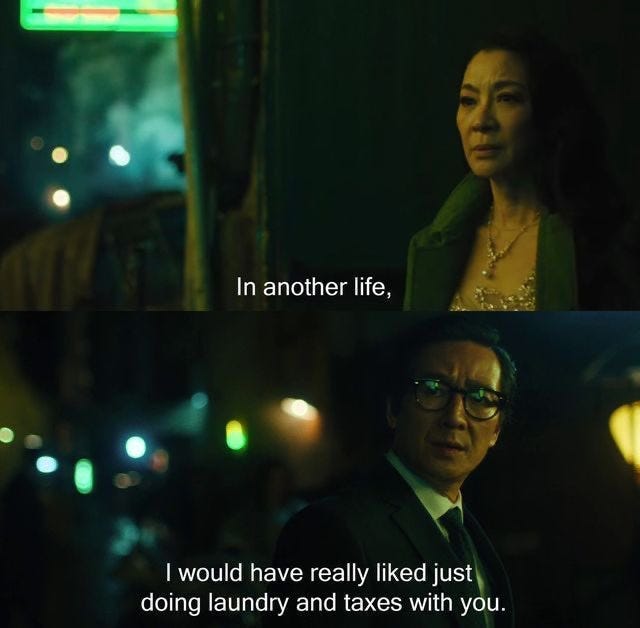
And yet, every big emotional beat drags her right back to that laundromat. Waymond, in the universe where he’s rich and she’s famous, and they’re not together, tells her that in another life he would have really liked just doing laundry and taxes with her. And at the climax, Evelyn looks at the daughter she’s been fighting with and tells her, “I will always, always want to be here with you.”
At the end of all things, with her very existence on the line, Evelyn wanted nothing more than to be there with her husband and daughter.
Think about who those voters are in the Academy, the ones who awarded it Best Picture. They’re the most successful people in the entire industry, the ones who got exactly the career everybody else in Hollywood is chasing. And a good portion of the general public too. They also live lives of well-known debauchery, entering and leaving marriages and parenthood like sliding doors, all while lecturing us on how to live. But then they watched a movie about a woman who turned away from every bigger, better life the universe could offer her so she could stay in a laundromat with her family, and they handed it the biggest award they’ve got.
And no, DEI-skeptics. It wasn’t because this movie had an almost entirely Asian cast. It wasn’t because Michelle Yeoh or director Daniel Kwan greased the right palms. I mean, they probably did, but so did all the other nominees. EEAAO won because the Academy voters felt something real at that ending, and probably spent a good deal of time afterward regretting something they had thrown away chasing their dream.
Even Rick and Morty Gives In
If there was one show I would have bet money on to hold the line on “family just holds you back,” it’s Rick and Morty. The entire show runs on the idea that nothing means anything and anyone who thinks otherwise is an idiot. Jerry, the dad, exists mostly so we have someone to laugh at. A time-worn trope in comedy shows, unfortunately.
Season 1, episode 8, “Rixty Minutes,” was written by Tom Kauffman and Justin Roiland for the show Dan Harmon co-created and ran. Rick hooks the family TV up to cable from infinite realities (yeah, we’re in the multi-verse again. It’s an easy way to explore what-ifs). He gives Jerry, Beth, and Summer (their daughter) a pair of goggles that lets them see their alternate lives. Jerry finds a version of himself living as a famous actor doing coke with Johnny Depp. Beth finds a version of herself who operates on people instead of horses (something she has a massive inferiority complex about).
Summer finds out that in most realities, she doesn’t exist at all. When she asks why, her parents come clean. She was an accident, they thought about getting an abortion, because they knew having a baby would cost them the lives they wanted. (Nice, guys. Really nice.) Summer, obviously distraught, starts packing to run away.
Morty stops her with what’s probably the most quoted speech the show ever did: “Nobody exists on purpose. Nobody belongs anywhere. Everybody’s gonna die. Come watch TV.”
People LOVE to quote the first three sentences as proof that the show is deep (aka nihlistic). They always leave off the fourth. The answer to a meaningless universe, according to Morty, who’s hardly an optimist, is to go sit on the couch with your family.
Meanwhile, Jerry and Beth have decided to split up. And to salve her pain, Beth is absorbed in watching the alternate version of herself on the goggles. Likewise, Jerry is watching the alternate version of himself on the TV with the rest of the family. And we see that version of Jerry, the famous one who got everything our Jerry ever wanted, having a full-blown breakdown on a mobility scooter while the cops follow him in a low-speed chase. He ends up on alternate Beth’s doorstep confessing that he hates his life, that he loves her, and “I wish you’d never had that abortion.”
The guy living as a movie star, beloved by the public, with all the celebrity friends can only think to go to his ex-girlfriend’s house in his most vulnerable moment, realizing that what he chose over life with her would never make him happy.
Our Jerry and Beth watch the whole thing and decide to stay together.
This is a show whose entire brand is “nothing matters,” but includes a wildly popular episode showing cleanly that it matters very much.
Hollywood’s loudest, most prevalent position is that you should go live your truth, whatever that costs the people at home. But every time one of these writers has to decide how the story actually ends, they write the guy who goes home.
That’s a hell of a thing to keep putting in your movies if you don’t believe it.
This was such a GREAT read! Another movie that could fit in this topic is The Debut.
Wow, this was an amazing essay. And I've never watched American Beauty, because I always heard it was a mean-spirited movie of a gay man's idea of how awful normal life is, but I will now. That tiny scene of Annette Benning clutching at his shirts--however she betrayed him (or whatever happened), that is the epitome of a life rocked to the core.