

Since adopting my “Internet Moralist” moniker, I’ve been trying to be slower with the clap-backs to inane comments online. Trolls are easily muted on the channel, so there’s no need to engage with them. But not all annoying comments are trolling. What I’m realizing is that some people (who I infer are younger millennials and zoomers) are genuinely confused about how to navigate long-form content. So enthralled with the patterns of short-form content that when confronted with things like titles, a thesis statement, and a case that takes 45 minutes to unroll, they feel like they’re being insulted or deceived.
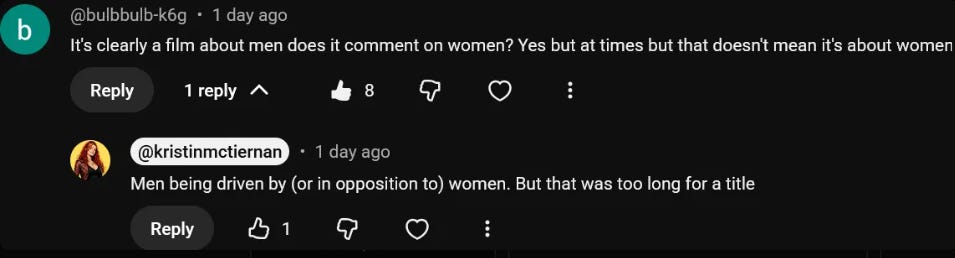
When my Fight Club video went live on YouTube this week, the comment section displayed in glorious technicolor that a lot of people under thirty can’t recognize an argument when they’re looking at it.
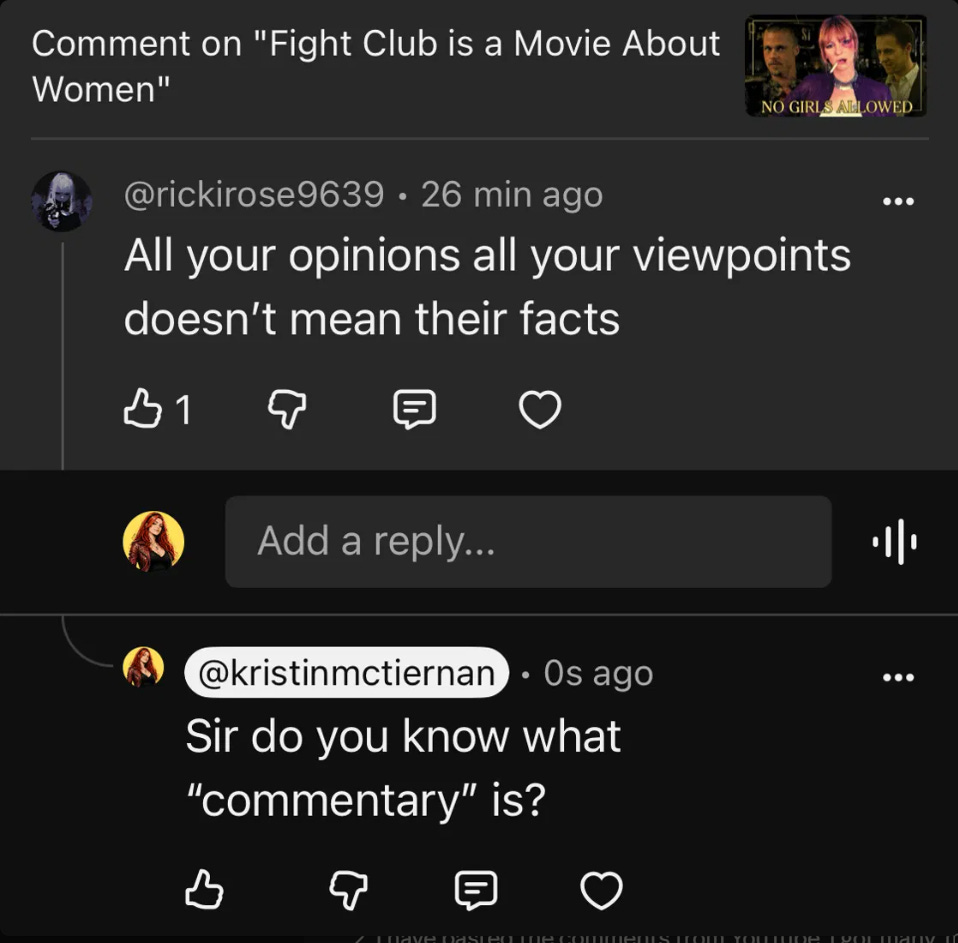

When I posted one of these to Substack, a second Zoomer showed up to say the first one had a point.
“Okay but it’s annoying when people assert opinions as fact.”
My first instinct was to be mean about it, and the great thing about Substack is it’s not Twitter. I knew she wasn’t being a jerk. She thought a judgment statement was the same as a fact. But when discussing art and the various interpretations of it, no facts are being presented at all (save the movie title and release date).
And yet the moral grandstanding comes with every video. “This title is clickbait!” “This is so ignorant!” (said the person who wasn’t born when the movie came out). Why? Why don’t they understand?
Because the younger set barely engage with long-form content at all anymore. According to the New York Times, they’re often not required to read full books in school, even honors English. The movies they watch are getting shorter and, at least on Netflix, they’re being made with the understanding that the viewer will also have their phone out while they “watch.”
The people who exist on a diet of Reels and Shorts arrive at long-form content with no idea what the parts are for. A Short has no title, no description, no thesis, and no sources. The first two seconds are the title. The caption is the description. The whole thing is over before an argument could form. If that’s the only format you’ve ever consumed, then a title that makes an assertion of any kind looks like a lie, and an intro that doesn’t contain the whole argument makes their eye twitch.
“You never said that!” They proclaim when I rebut their angry comment. Yes, I did. It was just past the 4 minute mark, where my younger audience statistically stops watching. For a 30 to 60-minute video.
So instead of finger wagging the youngins, as is my ill-tempered desire, I decided instead to write this article for a younger Millennial or a Zoomer who wants to make long-form content, or who wants to stop embarrassing himself under it.
Title, introduction, body, and sources all work together to form a cohesive argument. And if you understand this structure, even if you never make a piece of long-form content in your life, you’ll be more savvy, more literate, and more equipped to spot it when someone is full of shit.
The title is a claim, and a claim has to be able to be wrong
It’s easiest to use my Fight Club video as the case study. Don’t worry, you don’t need to have watched it. We’ll start with the thesis, which all my fellow aunties and uncs will remember as the central argument of an essay. It is to be the last sentence of your introduction, and then you spend the rest of the paper defending that one sentence. A video essay works mostly the same way.
My actual thesis came about four minutes in, and runs like this: Tyler Durden is against a world that runs on female rules, he’s right to be, but he makes the error of not being able to differentiate between the feminine order and an actual woman; that error is why his revolution ends in rubble.
That’s a neatly phrased paragraph which I hope even the worst performing student can understand. The thing is that a YouTube title gets about seven words. It has to contain the thing people actually type into the search bar (which is “Fight Club,” NOT “the feminine order in the work of David Fincher”), and it has to stop a thumb on a phone screen. “Fight Club is a Movie About Women” does all three. It’s searchable, it’s short, and you were sure it was wrong, which is why you clicked.
And no, snippy commenter. That’s NOT clickbait. It’s my thesis. Just shortened. You can tell because the title is something that a reasonable person could disagree with. “Fight Club is a Movie About Women” can be disagreed with. “Let’s Talk About Fight Club” cannot, which is why it would never get clicked, because it doesn’t tell you why you should care.
If I can’t make you care and take a position at the title, what are the chances you’re gonna listen to me blather on for 45 minutes? My tits aren’t that great.
Who am I kidding, yes they are. But they’re not fully on screen.
Clickbait has an actual definition and it’s not “title that made me curious enough to click.” Clickbait is a mismatch between packaging and payoff: the thumbnail shows a breakup that never happens, the title says “I’m quitting” over a video about a vacation. YouTube now has standards that punish this behavior. It’s not rewarded because viewers rightly hate it. So no, I’ve never done a clickbait title. You were just mad I didn’t fully satisfy your curiosity in the first 4 minutes.
The thumbnail has a simpler job. It’s Tyler, me, and Narrator, with me in the middle with a big black eye and a cigarette with NO GIRLS ALLOWED printed across the bottom. The sign says no girls and there’s a girl in the frame. Your eye catches the contradiction and your thumb stops.
The thumbnail, the video version of the book cover or movie poster, isn’t there to make a claim. It’s there to make you read the title, which then drives your curiosity to click on a video you can see is 45 minutes long.
The intro states the thesis. The body backs it up. That’s why it’s long.
Short-form front-loads everything because it has to. If you haven’t said the thing in three seconds, the viewer’s gone. People raised inside that constraint treat it as a law of nature, and then don’t know how to act when it comes to long-form commentary. This is for print and video.
The intro’s job is to state the thesis and tell you how I’m going to get there. It’s also good if I have some nice visuals and a hook so you’re interested as well as informed.
Then I (painstakingly, I assure you) structure the body to lay out my argument and explain why I made the assertion in the thesis.
“Here are the scenes of the movie that made me interpret it this way.”
“Here is a review by someone I respect who believed something opposite of my interpretation and here’s why I think he’s wrong.”
“Here is a work of scholarly nonfiction that lays out the themes of this movie.”
The first thing I did in the Fight Club video is show you the two camps I’m arguing against, and I show them at their strongest: The progressive critics who read the film as a toxic masculinity warning get Roger Ebert. The manosphere side gets the Red Pill forum posts that treat the film as a manual. I quote both and I assert they’re both wrong about the same thing. This is not a statement of fact. It is obviously an opinion. A judgment call. And it is upon me to show you how I arrived at the conclusion through the course of the video.
When providing “evidence” for commentary, there are three kinds that I typically use, since I comment on film and stories.
Primary evidence is the film itself. The Narrator’s opening voiceover tells you, with a gun in his mouth, that all of this has something to do with a girl named Marla Singer. I put it on screen because it’s the thesis of the film stated by the film. After that, I walk through the five things Tyler does in the first half and show that every one of them is a refusal of a specific feminine rule. Every clip plays while I talk. You aren’t being asked to trust my memory of the movie.

Authorial evidence is what the people who made the thing said about it. Chuck Palahniuk’s afterword to the novel says the idea came partly from watching street gangs, young men teaching each other to be men because nobody else would. David Fincher told the Guardian in 2023 that he can’t understand people who don’t see Tyler as a negative figure. I use both, and I use Fincher against himself, because even he acknowledged what he thought he was communicating with the film is not what most of the audience received.
Outside evidence is the material that supports the real-world claim the movie is a vehicle for. The argument that men build because they’re trying to earn women comes from Geoffrey Miller’s The Mating Mind and Camille Paglia’s Sexual Personae, both cited. The argument that Tyler copied Marine Corps breakdown tactics without the Corps’ second half, the building back up, comes from my own four years as a Marine and from a two-part video series by Lost Things Found, a former enlisted Marine, also cited.
Every one of those sources is linked in the video description, under the heading SOURCES, with dates and URLs for any viewer who just clicks on …more.
But the snippy commenters don’t click on it. They don’t care that it’s well sourced. They just care that it’s not what they would have said if they made a video about Fight Club.
How to assess an argument, including mine
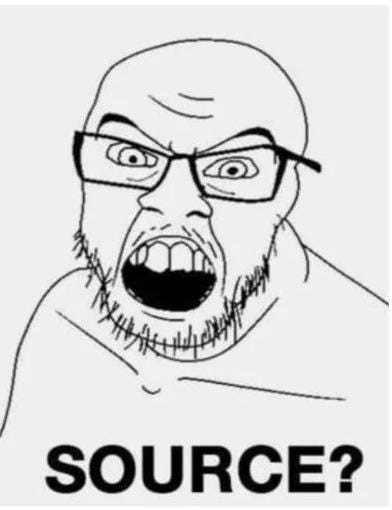
The thing about arguments is that they’re not all the same. You’re right to be mad at a fact just thrown out there as opinion. You’re not right to demand a source when someone expresses an opinion. Never be this guy.
When assessing an argument, there are four questions you need to ask yourself.
What kind of claim is it? There are preferences, which are things like I prefer the 1999 poster to the DVD cover, and nobody can argue with those. There are facts, which can be checked. And there are judgments, which are claims with reasons attached, and which are assessed by attacking the reasons. “Fight Club is a movie about women” is a judgment. “Everyone’s entitled to their opinion” was a courtesy invented for preferences, and somewhere along the way it got stretched over judgments too, so that now a person can wave off an hour-long argument that took weeks to construct with, “Pshhh, I mean, that’s just your opinion, man.”

Where is the evidence, and what kind is it? Is the creator showing you the text or telling you about it? Are the scenes on screen? Are the outside sources named? “Trust me, bro” is the weakest evidence there is, and a video built entirely on it should be discounted no matter how confident the delivery.
Did the creator answer the strongest objection, or only the weak ones? I answered the “Hollywood cop-out ending” complaint from the manosphere side because it’s the best objection to my reading, and if I’d skipped it you’d have been right to say the case was thin. It would also be a slap in the face to my primarily male audience and the film’s primarily male fan base.
And then, if you disagree with the argument, can you say what you disagree with? A real objection has three parts. You name the specific claim, the evidence you dispute, and offer your own reading of the same evidence. I got a lot of good comments under my video, many with their own interpretations of the film or characters. But none of those were combative. They just wanted to tell me how they read it differently. It’s hard to know how old anyone is on YouTube. All I can say is that the thoughtful commenters used capital letters and typed in complete sentences. And there were no emojis or zoomer slang. That’s all I’m saying.

“That’s just your opinion” is worse than silence
My rules for the comments section, both here and on YouTube, are simple: Come correct or not at all.
A simple edict, you’d think.
What I want to explain to you is that the whole, “that’s just your opinion, man,” is actually worse than no comment at all. It’s also worse than the edge-lords 'lol whys this foid talkin”
The reason it’s worse is because you said something designed to end the conversation without entering it. “That’s just your opinion” doesn’t dispute a claim. It disputes my right to have made one. Maybe you actually did watch the whole video, probably on 2x speed, but fine, whatever. And you were mad the whole time. Something I said rubbed you the wrong way. But you couldn’t verbalize it. You damn sure weren’t gonna do the work to point out what precisely I said that made you mad or explain how it was wrong. Nope not you. That’s labor. And you do not dream of labor.
So instead you shart out, “well, that’s just your opinion,” perhaps never realizing how stupid and lazy it makes you look.
Your reputation aside, because you probably change your username on the regular, if you don’t look into arguments you disagree with, then it’s probably safe to say you don’t look into the ones you agree with either.
And if you unquestioningly believe everything said by people you like, and unquestioningly reject everything said by people you don’t, please understand how easily manipulated you are.
Funny how when we state something it's all Big Lebowski "Well that's your opinion, man." But when they state it, it's fact. I get this a lot when I push back on the "Reading is always political" crowd; I always get at least 5 comments "But reading IS inherently political" with no context or actual argument. At least the comments give me engagement
Trolls seem to have disproportionate difficulty with the difference between "their" and "they're" etc, it's weird.