8 min read
I will pine for nothing. I will make it so.

Project 2004: We Have to Go Back

Project 2004: We Have to Go Back

There's a whole genre of content about how terrible the 2020s are: TikToks about the "Zoomer Stare" and other antisocial and downright dangerous behavior from the younger cohort; Furious screeds on X about the humiliation ritual of air travel; Thirty- to fifty-minute YouTube videos that compile TikToks about hyperconsumerism, Gen Alpha's illiteracy, and the horrific relationship and dating landscape.

The diagnosis is in: Society sucks, people suck, and all we can do is watch reruns of Friends and The X-Files with tears in our eyes, longing for how things used to be.
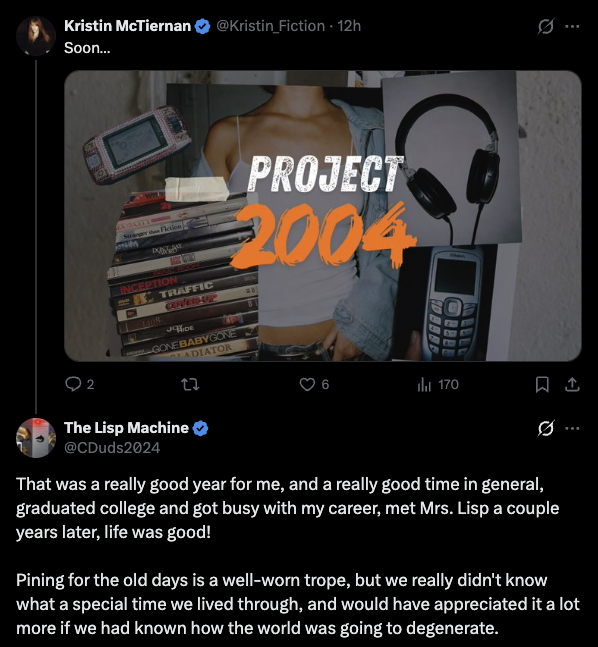
But I disagree. Though there are some aspects of life in 2026 that cannot be escaped (the economic conditions being a major one), we can actually pinpoint when our way of life went spectacularly to shit, and we have the power, at least in small ways, to wind the clock back.

I will pine for nothing. I will make it so.

Project 2004 Begins Now

via GIPHY

I've long said that the only people we have control over are ourselves, so that's what this project is about. So when I quote Jack from Lost "We have to go back!" What I really mean is I intend to go back. And if you like, you can come along.

The underlying project is unglamorous: a series of small decisions, made one by one, in a different direction than the one I'd been drifting in for years without ever consciously choosing it. The first of those decisions is targeting my deteriorating attention span, love of reading and writing, and general ability to tolerate quiet and boredom.

I have created a curriculum for a self-paced Master of Fine Arts (MFA) in Fiction, modeled as closely as I could manage on what a solid mid-tier American university would have offered between 1997 and 2002. The structure runs two years across four semesters, with simulated workshops, craft seminars, literature reading, and a thesis manuscript at the end. The initial announcement was received with great enthusiasm over on Substack.

Kristin McTiernan (@kristinmctiernan)
People have a lot of opinions about getting an MFA. And by “opinions” I mean unvarnished derision. Like a lot of things, the previously useful MFA has become a farcical vanity project for the worst people you know. Which is why I have created my own MFA curriculum based on mid-tier universities circa 1997. Because self-care sometimes means ignoring everything after 9/11

Why focus on 1997? The short version is that I wanted a curriculum from the last possible moment before the English department converted itself into a sorting facility for grievance categories. Janet Burroway's Writing Fiction has been the standard American creative writing textbook since the early 1980s, and it teaches you how to build a scene. John Gardner's The Art of Fiction is the most assigned craft book in MFA history, and it spends its pages on the mechanics of what Gardner calls "the vivid and continuous dream," with no time wasted on which identities are currently underrepresented in the dream-having demographic. Flannery O'Connor's essays in Mystery and Manners will tell you, with no apology and no buffer, that "the writer can choose what he writes about but he cannot choose what he is able to make live," which is the kind of sentence I want close at hand for the rest of my career.

I divided the first semester into a nine-week session because designing a curriculum I couldn't actually complete would defeat the entire point. I do still have a job, a business, and a family, after all.

Session 1 covers Burroway's first five chapters (writing process, showing versus telling, two chapters on characterization, and setting), Gardner front to back, and the essential essays from Mystery and Manners. By the end of nine weeks, I'll have produced one complete short story (drafted and revised), eight to ten one-page craft analyses, and the beginnings of a revision journal. The reading and writing load runs eight to twelve hours a week, which is a perfectly doable schedule for someone with a full-time job, and if you're telling me you don't have eight free hours a week, I'd be very interested in seeing your screen time report.

To be fair, mine is thoroughly shameful.

The full Session 1 curriculum is available HERE, with no paywall, but you will need to sign up (or sign in for existing subscribers).

Used paperbacks of all the texts will run you under thirty dollars total. I'll be publishing my craft analyses and reflections on this site as I work through the program, and the Self-Paced MFA will be its own playlist on the Nonsense-Free Kristin YouTube channel.

Thank you, ThriftBooks

Just be clear: This is not a course, there is no cohort, and I will not be hosting a Discord or running Zoom workshops or building any kind of group around it. And there's NO UPSELL. You can support my work by becoming a paid subscriber or by watching my videos on YouTube without an ad blocker, but it will never be a requirement.

You can do this on your own, at your own pace, and if you want feedback on what you write, find one trusted reader. One reader is plenty. An MFA program works mostly because it forces you to keep showing up, and the self-paced version works only if you build that discipline yourself. Which is exactly the appeal for doing this.

What's Wrong with a REAL University MFA?

The natural question here is why I didn't just go get a real one. The programs exist in about every major university, and twenty years ago, it would have been the obvious move. However...

In addition to the insane levels of ideological capture in US education, but most especially the universities, the very people who are most entrenched in higher learning are telling us not to.

Ann Patchett, who is about as establishment as American letters gets, has a standing piece of advice on the subject: "No one should go into debt to study creative writing." She has been repeating that line for at least a decade, in essays and interviews, and her reasoning is straightforward. An MFA, unlike medical school or law school, leads nowhere in particular.

Most MFA students (especially at prestigious universities) are seeking one of two things: a book deal or a tenure-track teaching position. Patchett informs us that the degree will get you neither. Junot Diaz, who teaches at MIT and is presumably in a position to know, has said publicly that creative writing programs are an effective way to put young people into six-figure debt while ensuring they finish college without learning anything practical.

That last one shouldn't be a surprise, honestly. As commentator Michael Knowles often tells us, the liberal arts are not designed to get you a job; it's not a vocational program. They are designed for the higher parts of us. But university is now so expensive that only the exceptionally wealthy have the luxury of such considerations.

The financial argument alone is sufficient to talk most adults with mortgages out of the idea. But there is a separate question, which most writers in my position avoid, about what is actually being taught at these programs now. I'm less inclined to avoid it.

The dominant pedagogical approach in American creative writing programs over the past fifteen years has shifted toward identity-first frameworks, with craft increasingly treated as a secondary concern behind a writer's lived experience and political alignment.

In case you think I'm making this up, the trade publication of record, Poets & Writers, published a piece in 2022 titled "Return to the MFA: A Call for Systemic Change in the Literary Arts," which criticized contemporary MFA programs for "fetishizing craft" at the expense of what the author called collective political responsibility. When the major trade publication is publishing arguments that craft itself is the problem, you have to wonder whether the institution still does the thing it claims to do.

So I didn't apply. Even if I had been admitted somewhere fully funded, I don't have two years to dedicate to a residency, and I'm especially not interested in writing under the supervision of professors whose first question about a manuscript will be about whose voices it centers. What I want from an MFA is the books, the production schedule, and the discipline. All three are replicable on my own terms.

The Rest of the Project

The MFA is just one piece of Project 2004. It's a long way from the whole story. I'll be laying out the full scope in a video on the Nonsense-Free Kristin channel this coming Thursday.

The reason I burned out on reading and writing is the same reason I've been generally miserable, and most of it has very little to do with my career or my workload or any of the obvious suspects. It has to do with the way American daily life is now structured, which is very different from the daily life I had at twenty-one, when I walked everywhere with a book in my bag and had no idea what anyone on the internet thought about anything, including me.

I was happier in that life. I assume that sounds suspicious to anyone reading this who is still in their twenties, the way claims of past happiness always sound to people who weren't there to verify them. The young will have to take it on faith that being broke and walking through bad weather to a job that paid ten dollars an hour can, in fact, constitute a happier existence than scrolling at home in heated comfort under a thirty-thousand-dollar student loan you'll be paying off until you're forty.

Most of what made that life better had less to do with the year on the calendar and more to do with what hadn't yet arrived: the tracking infrastructure, the constant availability, the algorithmic feeds engineered to keep you angry, the assumption that any stranger with a phone is entitled to your time and emotional bandwidth, the slow conversion of every previously human transaction into a screen with a subscription attached.

Some of that is irreversible, and I'm aware of that. I cannot move to a cabin in the woods, or even a convent, at this point. I am, however, going to undo as many of the changes I can undo within the constraints of an actual adult life with a job and a husband and businesses to run, document the process, and report back as I go. That's Project 2004.

The full picture goes up Thursday on the Nonsense-Free Kristin channel. If you're not subscribed, fix that now and turn on notifications so the algorithm doesn't bury it. The video covers what I'm changing, why I'm changing it, and what I expect to happen as a result. I'll see you there.

Nonsense-Free Kristin
For rebellious writers and creators who refuse to play by broken rules. This channel covers what it takes to build a sustainable creative life outside traditional publishing, alongside the broader question of how to live and work without losing your mind in the 2020s. What you’ll find here: - Practical advice on writing craft, indie publishing, marketing, and platform-building - Interviews with working authors, creators, and the occasional interesting service provider - Cultural commentary on books, film, television, and the slow degradation of contemporary life - Project 2004: my ongoing experiment in rebuilding a saner pre-iPhone existence, one decision at a time - The Self-Paced MFA: a 1997-style fiction curriculum I’m working through in public Be your own signal. 📧 Newsletter & essays: kristinmctiernan.com ✍️ Editing services: nonsensefreeeditor.com
Subscribe to my newsletter

Subscribe to get the latest articles and news

Member discussion