
They Will Kill You (And Call It Entertainment)

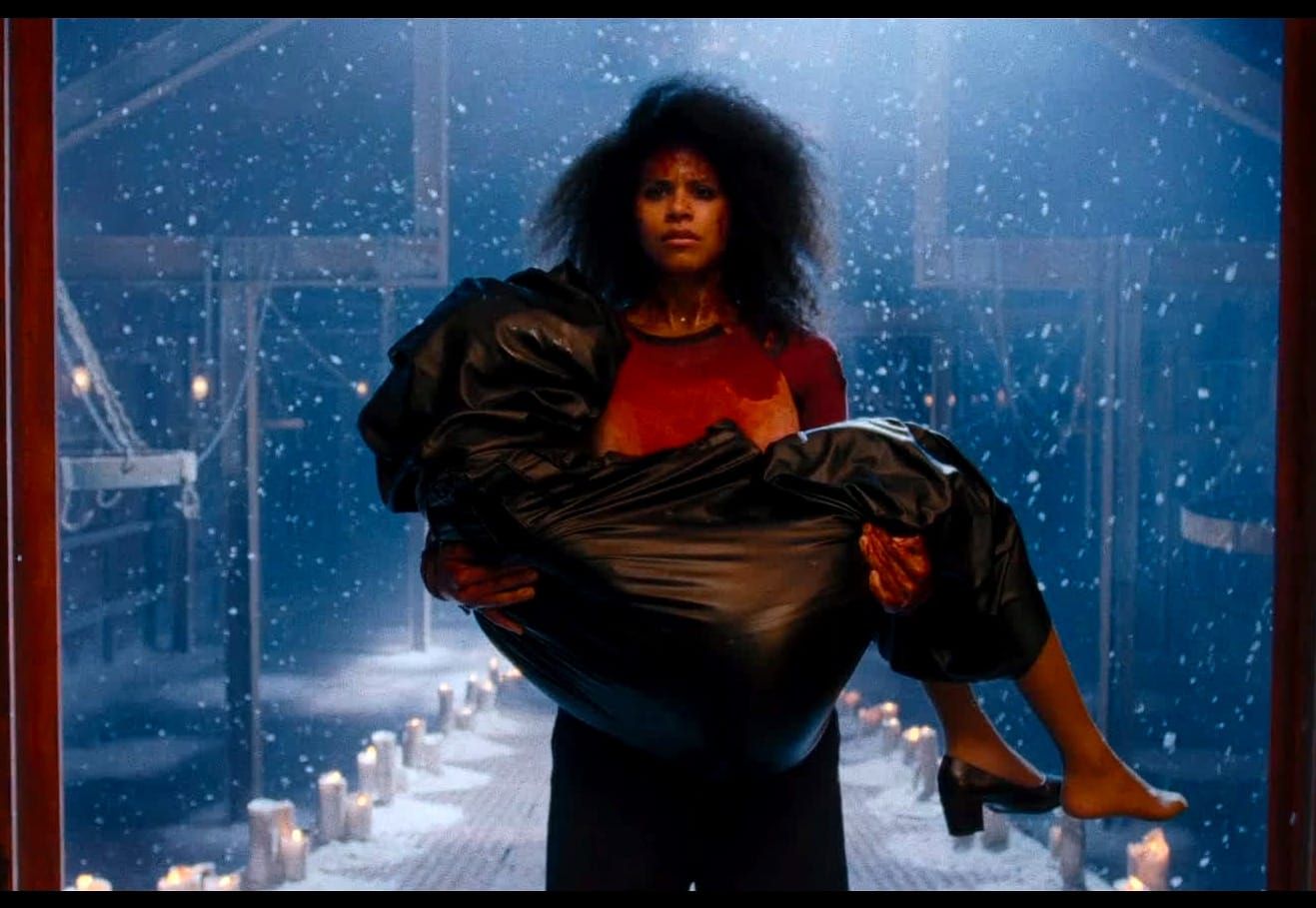
When the poor give to the rich, the devil laughs.
That's the text on screen before a single frame of They Will Kill You (2026) plays. It's a proverb, allegedly Haitian, and it tells you exactly what the next ninety-four minutes are about. Wealthy people consuming poor people. Or at least that's what the movie thinks it's about.
They Will Kill You follows Asia Reaves (Zazie Beetz), an ex-convict who takes a housekeeping job at the Virgil, an exclusive Manhattan high-rise that's been losing staff for decades. Asia wasn't actually hired for this position; she's posing as the maid who was supposed to report for duty, and it takes us a few minutes into the run time to figure out why. It takes us decidedly less time to see something is very wrong with the Virgil.
The thing about They Will Kill You is it has all the hallmarks of a horror movie. It's gory, with over-the-top violence, plus all the quips and meta-awareness popularized in the first Scream movie. But the true horror of this kind of story--one of the wealthy elite sacrificing their lessers to Satan for their own enrichment--is strangely glossed over. The film is cartoonish in its violence, with heads getting lopped off and reattached and a sentient eyeball that pursues Asia in her escape attempts.
It's all very funny. In a gross way. I imagine it got good laughs in the theater. That's the entire point.
Because as long as you're laughing, you don't have to think about why this particular story keeps getting told.
They Will Kill You was one of two major studio films that told functionally identical stories--released within seven days of each other in March 2026. The other was Ready or Not 2: Here I Come (Searchlight Pictures, March 20). Both follow a resourceful young woman fighting for survival inside a luxury property controlled by a cabal of wealthy Satanists. Both women have an estranged sister caught inside the system. Both films treat their elite villains as bumbling, entitled grotesques who can't fight their own battles. Both films frame the Satanic element as literal, with real demons granting real immortality in exchange for real human sacrifice.
Two studios don't greenlight the same movie at the same time by accident. They greenlight it because the market research says the audience has an appetite. And the appetite in 2026 is for stories about rich people who worship the devil and prey on the vulnerable.
The question is why?
Hey is it possible that all the new young actors are nepo babies because normie parents now know that Hollywood is just a human trafficking operation and they’re not willing to give casting agents/pimps their contact info anymore? https://t.co/O7FF2kcbfs
— Kristin McTiernan (@Kristin_Fiction) May 12, 2026
The conspiracy-theory version of this story has been circulating for years. QAnon and its offshoots built an entire mythology around Satan-worshipping elites trafficking children, drinking blood, and performing occult rituals. The 2020s saw these claims migrate from fringe forums into mainstream political discourse. Pizzagate. Wayfair. Balenciaga. Whatever the hell was going on with Chrissy Teigan's Twitter account. Everywhere you looked, someone was connecting the dots between celebrity culture, occult imagery, and child exploitation.
And every time, the reasonable response from institutions and media was the same: these people are crazy.
The problem with that is some of the stories of those "crazy people", those "addicts", those "mentally ill people" had the nasty habit of turning out to be partially or entirely true.
Evil Through the Atheist's Eyes
For those who haven't seen it, the setup is straightforward. A decade before the film begins, teenage Asia shoots her abusive father while trying to escape with her younger sister Maria. Asia goes to prison while Maria goes back to their father. Ten years later, Asia gets out and hires a private investigator who tracks Maria to the Virgil. Where she gets the money to do this is never mentioned. Asia takes another woman's identity, reports for the housekeeping job, and walks in armed.
She finds what you'd expect from the title. The Virgil was built in 1923 as a temple to Satan. Its residents are wealthy, immortal, and bored. They maintain their immortality through an annual human sacrifice, brokered through a demonic entity that inhabits a severed pig's head suspended on a chain. Write your name on the head, kill someone, and you live forever. Get your name erased and you're mortal again. The cult recruits its sacrificial victims from among the "oppressed" class. People of color, immigrants... people who won't be missed. Or if they are, they won't be reported.
Asia fights her way through the building floor by floor, dispatching cult members who keep regenerating because they can't actually die while their names are on the list. She discovers Maria is alive, but not a prisoner. Maria has also made a deal with the devil for a family, belonging, and immortality. Now all she needs is a sacrifice to seal the deal.
The climax involves Asia destroying the cult by burning the pig head, erasing every name, and rendering the immortals mortal just long enough for their accumulated injuries to kill them. She carries Maria's body out into daylight, only for her sister to revive.
You see, Asia made a deal with the devil too. Bring my sister back, and I'll give you a lot more than one life in exchange.
Now both sisters are immortal, sustained by the same Satanic transaction that powered the cult they just destroyed.
The film frames this as a happy ending.
Because of course it does. Hollywood loves their satanic cult and demon possession movies, but they never get it quite right. The writers of Hollywood, the ones blessed by the establishment and permitted to make ungodly amounts of money for sometimes mere hours of work, don't quite understand the devil. Or evil.
How could they? The fish cannot perceive the water in which it swims.
There is no eternal soul in this story. Certainly no God, the awesome and terrible creator of all. There is only evil and a battle for who can harness it best.
And if that framing surprises you, I'm afraid you haven't been paying attention.
We See Now. There is No Unseeing.
The entertainment industry has, for decades, operated a system in which access to career advancement requires submission to the sexual demands of powerful gatekeepers, and silence about those demands is enforced through blackmail, legal intimidation, and the threat of professional annihilation.
Coming along with those demands are the requirement to tow the party line. Or did you really think every single actor, musician, and tangentially famous person really had identical opinions about social and geopolitics?
That's not a conspiracy theory and we don't need any supernatural intuition to know how they operate. Not anymore, anyway. For a very, very long time, you couldn't even hint at the truth without serious consequences. It's only now, in the age of social media and cell phones, when you don't need the mainstream media's blessing to get the word out, that a few brave souls have finally spoken out. And it was like a dam bursting.

That being said, the way the insiders have to speak out usually has to be subtle. The rot is not gone. The bad guys are not all behind bars now. It's not over, even as Hollywood circles the drain. The people who stayed silent for all that time still have a lot to lose. And they don't want to lose their "immortality." They don't want to have their name crossed off the list... like Sean Combs did.
That's Puff Daddy or P. Diddy for those who don't know. For decades, Combs operated what federal prosecutors described as a criminal enterprise that used the resources of his business empire to facilitate sex trafficking, forced labor, and systematic abuse. The indictment detailed how employees, security staff, personal assistants, and high-ranking supervisors acted as intermediaries to carry out and cover up his conduct.

A 2016 surveillance video captured Combs kicking, dragging, and throwing a vase at his then-girlfriend Cassie Ventura in a Los Angeles hotel hallway. Again, 2016. But it wasn't until 2024 that the video "resurfaced." Who was responsible for making it go away in the first place? And how did it suddenly come to light?
And why did those people who had been silent for so long suddenly start talking all at once? Why were victims who were once dismissed, threatened with lawsuits, and even institutionalization suddenly and uncritically believed?
A jury convicted Combs in July 2025 on two counts of transporting women for prostitution, though acquitted on the racketeering and sex trafficking charges.
The timeline is instructive. For decades, his victims were silenced, erased, and discredited, even though everyone knew. Actors, singers, bodyguards. All of them. It was only after the protection was removed from Combs that his egregious sins got any press at all. The video didn't surface because someone found it. It surfaced because someone decided it was time. The whole sequence has the hallmarks of someone whose name was erased from the list, to borrow the film's own vocabulary.
And that vocabulary is precisely the problem. In They Will Kill You, the mechanism of protection and destruction is literally Satanic. Your name on the pig head keeps you alive. Your name comes off the pig head, and you're finished. The film externalizes a real institutional process, the granting and revoking of protection by powerful interests, and attributes it to the devil. Which makes it safe. Which makes it fiction.
And lets the writer, director, and all the actors keep their jobs. And maybe their lives.
Because they know they're not safe. Weinstein behind bars changes nothing.
The Combs case illustrates what happens when the protection gets revoked, but Corey Feldman illustrates what happens to victims when they cross those who still have it.
In 2011, Feldman told ABC's Nightline that the number one problem in Hollywood was and always would be pedophilia. He called it the industry's biggest secret. Two years later, promoting his memoir Coreyography on The View, he repeated the claim, drawing from his own experience as a child actor in the 1980s who had been surrounded by predators from the age of fourteen. He described how his close friend and co-star Corey Haim had been sexually assaulted on a movie set at age eleven.

Barbara Walters scolded him, telling him he was damaging an entire industry, and called him "irresponsible."
And it didn't stop with Barbara Wawa, may she rest in piss. The pile-on came in earnest with credentialed journos and sleezy tabloids alike citing (and mocking) Feldman's substance abuse history, his "quirky public persona," and his previous friendship with Michael Jackson was questioned. Media outlets treated his claims with performative skepticism, not because the claims were unbelievable, but because believing them would require action that nobody with institutional power wanted to take.
When Feldman tried to name names, he was told he needed a team of lawyers and a security detail. When he went on the Today show, Matt Lauer, himself a man who would later be accused of sexual assault by multiple women, pressed him on why he wouldn't just say the names on camera. The implicit demand was clear: either make yourself legally and physically vulnerable right now, on our terms, or accept that no one will take you seriously.
And of course Matt knew exactly what he was doing.
Feldman was a warning. "We made you who you are and we can take everything away." Every person in the industry who considered speaking up could look at what happened to him and calculate the cost.
Satanists & Producers Pick Their Victims Well
Which brings us back to They Will Kill You and its ending, which the film presents as Asia and her sister winning something. They fought those evil rich people and beat them at their own game. Or something.
The building specifically recruits workers (sacrifices) from vulnerable populations, people without documentation, connections, or anyone who would come looking for them. It's not dwelled upon in the movie, but it's reasonable to assume that even if one of the sacrifices managed to get free from the building with its locks, traps, and shatter-proof windows, they would still be in danger on the outside due to the status of their hunters.
Once picked, they'll never be safe again.
That framing tells a true story that the screenplay doesn't want to examine. The entertainment industry has always drawn its most exploitable labor from populations with the least recourse. Young actors without family support. (Look into Edward Furlong and Brad Renfro, may he rest in peace). People from backgrounds where reporting abuse to authorities is either impossible or pointless. Corey Haim was a child from a broken home. The women in Combs's orbit were universally from terrible home environments, poverty, and many were young sex workers. Their position made them dependent on him and his good will.
You have to wonder if the same can be said for every single young ingenue in Hollywood. Or should we believe that they were truly the best and most beautiful the world had to offer?
The film puts that reality on screen and then drowns it in so much gore and comedy that you can't hold it in your mind as a real thing. You laugh at the pig head and cheer when Asia blows Heather Graham's head off for the fifth time. And you walk out of the theater with your anxiety about Hollywood exploitation safely discharged, because the girl won.
She didn't, though. She just joined the other side. And you just paid fifteen dollars to watch Hollywood tell you exactly how it operates, wrapped in enough absurdity that you'd never take it seriously.
When the poor give to the rich, the devil laughs.
Written by

Join Us
Free subscribers get weekly essays on morality, culture, and character through fiction. Paid subscribers get everything.




![Reality is [Not] Problematic: The Women of Heat](https://storage.ghost.io/c/23/9d/239d5673-09ac-4d33-895f-aea9726a4fb0/content/images/size/w1140/2026/09/AshleyJuddHeat-010125-02-08a3ba82211145dfa2d14be773d86875.jpg)


Member discussion