Author incomes are in freefall and the publishing industry can't stop arguing about whose fault it is. Books are getting shorter, simpler, and more formulaic, and yet the readers who would actually sustain author careers keep walking away. The conversation about why has been stuck in a loop for years, and a recent video helped clarify the answer.
CriminOlly, a UK-based BookTuber who covers crime fiction and publishing with actual rigor, recently posted a video titled "Author Incomes Are Dropping and Apparently It's Our Fault." The "our" refers to readers, btw.
The title is intentionally confrontational, of course. That's how you get clicks for your video. But his points are solid. Readers say the shelves are full of identical books they didn't ask for, and don't want, which is why they're not buying new releases. They're still reading, but sourcing their material outside of the big retailers.
Publishers counter that they are releasing what people want, as demonstrated by buying patterns, rather than what people whine about on the internet. I know better than most the difference between what people say they want and what they'll actually spend money on, so it's hard to call malarky on their point.
HOWEVER, those same publishers have made it clear they consider it their job to publish only the "right" voices, rather than making mercenary calculations about what will sell best.
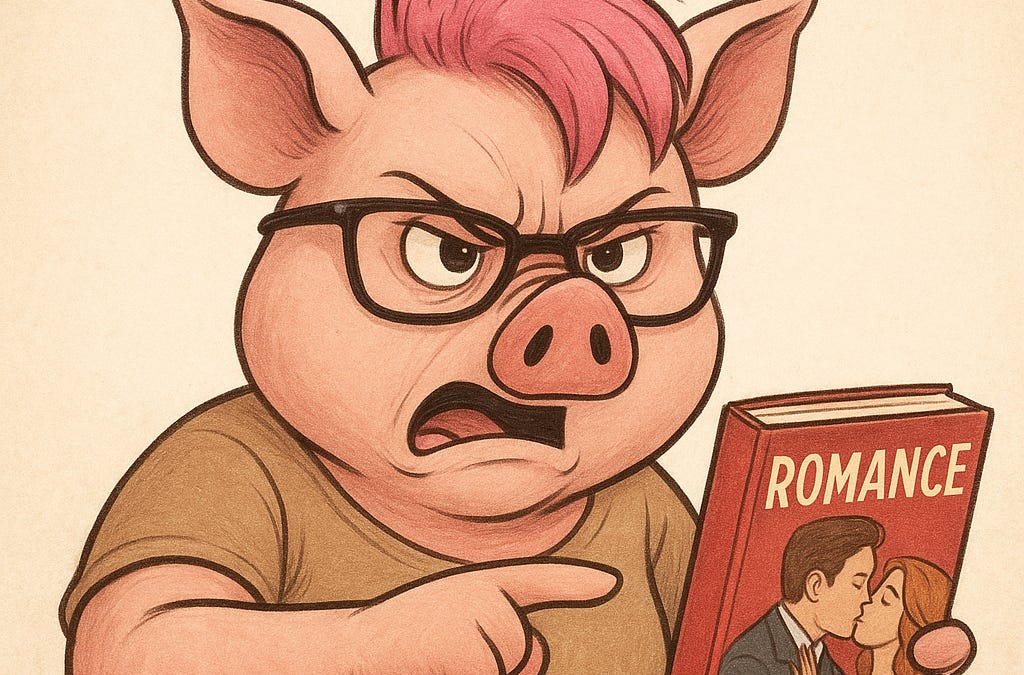
Yes, they have data showing that, of the new releases, the stupid, smutty books with cartoon covers and vapid female protagonists sell best. But it's a stacked deck. They have already excluded the authors and works that don't fit in their worldview. So the sample they're drawing sales figures from are heavily skewed in favor of their own worldview... which they think the unwashed public will read if they have no alternative.
As it turns out, we won't.
My acerbic besties in the Redpill space would happily tell you, "You can't negotiate desire." It's as true of commerce as it is in romance.
You're not gonna scold your way into a sale.

The blame loop is satisfying in the way that all circular arguments are satisfying. You get to feel right without having to change anything. Publishers can point at sales figures. Readers can point at the product. Authors, stuck in the middle, get to feel screwed by both parties, which is at least emotionally accurate even if it solves nothing.
The Wrong Question, Served to 2 Different Populations
My most recent YouTube video (the one this essay accompanies) covers the gamification of reading, the rise of performative literacy through BookTok, and the slow erosion of deep reading as a practiced skill. In it, I separate the supposed reading public into two groups that the publishing industry stubbornly refuses to distinguish between.
The first group consists of younger readers who are exhibiting genuine cognitive deficits when it comes to sustained reading. Teachers at elite universities have been sounding the alarm for years now: students can't finish a novel, can't follow a long argument, and can't even sit with a text without reaching for their phone. This is a real and serious problem, and I covered it in detail in a previous video.
The second group is everyone else. Adults over thirty, roughly speaking, who grew up reading books the old-fashioned way and whose literacy is perfectly intact. These people aren't struggling to read, but rather are choosing not to buy what the publishing industry is currently selling.
Most aren't going full Project 2004 like I am, but that distinction in consumer groups changes the entire conversation.
When publishers respond to declining sales by shortening books, simplifying prose, and leaning hard into first-person present tense with skimmable emotional beats, they're optimizing for the first group. The Zoomers and the Alphas. The data supports this: the average length of a New York Times bestseller dropped by over fifty pages between 2011 and 2021, and the share of books over 400 pages fell from 54% to 38% in the same window.
The problem is that this strategy actively repels the second group. You know, me. And probably you. We're the readers with money, attention spans, and an established buying habit. We're the ones going into stores, looking at the new releases, and walking away. Probably walking our fat asses over to Cinnabon if we're being honest.
The over-30 cohort simply walking away doesn't show up in complaints or one-star reviews or angry tweets. Usually. And if it does, the complainers are dismissed as "chuds" or "problematic" or "misogynist." Usually it just means that the customer who used to buy twelve books a year (even as they get more expensive) is now buying three, leaving the publisher to shrug and pump out yet another Millennial-speak cozy-fantasy slop book.
Why Do Consumers Actually Read Books (and Love Them)?
I can already hear the objection forming: "But people have always liked easy reads, and the bestseller list has always been dominated by genre fiction." True. And thank you for making my point for me.
Dan Brown's The Da Vinci Code was the bestselling fiction title in both 2003 and 2004, sitting atop the New York Times hardcover list for a cumulative 48 weeks across those two years. It has sold over 80 million copies worldwide, spawned a $758 million film, and generated an estimated $1.2 billion in total Da Vinci-related revenue.
I'm not the first to say it: the prose is not good. Literary critics savaged it then and savage it now, and they're correct on the technical merits. The sentences are clunky, the dialogue is wooden, and the pacing in the middle sags like a church roof in a Dan Brown novel.
None of that mattered. And the reason none of that mattered is worth examining closely, because it reveals everything the current publishing formula gets wrong.
The Da Vinci Code gave its readers a problem to solve. It also gave them a side to take (is it blasphemous? Is it true?). It gave them a reason to argue with their coworkers at lunch about whether the Catholic Church was hiding something, whether the Priory of Sion was real, whether Leonardo da Vinci actually embedded secret codes in his paintings, and whether Jesus went to his short-lived grave a virgin.
This wasn't just something to read. Readers were participating in the book, long after they finished it. They were doing research on the side. Many bought copies for friends specifically so they could have someone to debate with. The Catholic Church's condemnation of the book functioned as the most effective marketing campaign in publishing history precisely because it confirmed the book's own premise: powerful institutions don't want you to know this.
You'd think the Church would have learned from the success of Kevin Smith's Dogma (thanks largely to their protests), but no. No lessons learned.

Go back further. Nobody had to cajole adults and children alike into waiting in line, in costume, at midnight for the next Harry Potter book. Nobody manufactured the Sorting Hat quizzes, the fan fiction, or the house rivalries. Yes, I am a Slytherin. Thank you for asking.
Those behaviors were natural extensions of what the books themselves were doing. Rowling built a world that invited participation, and readers accepted the invitation because the books gave them something to do with their enthusiasm besides buy the next one.

Now look at the current writing formula. First-person present tense. Female protagonist. Emotional interiority turned up to eleven. A prose style designed to be skimmed between the "spicy" parts (an observation, I should note, made by the readers themselves on BookTok, often with pride). These books move copies on release week. Some of them move a lot of copies because they go viral. But they generate no cultural momentum. Nobody is debating the theological implications of the latest romantasy at the office. Not even the one about fucking one of the 4 Horsemen. No, I'm not kidding.
Today in bookish depravity, women ravenously devour the story of getting roughly mounted by… *double checks book blurb* a Horseman of the Apocalypse pic.twitter.com/ZkvugdOuZH
— Kristin McTiernan (@Kristin_Fiction) June 13, 2026
Nobody is forming theories about the next installment of a dark romance series because the books don't pose questions. They deliver sensations. And sensations, by definition, do not have legs, even if said sensations occur between them.
The Da Vinci Code was, by every honest measure, a trashy airport thriller with delusions of grandeur. And it outperformed the entire current publishing model because it understood something that the industry has since forgotten: readers want to feel smart. They want to feel like they belong to something, and they want something to do with a book besides finish it.
What This Has to Do With Project 2004
My ongoing project to reclaim a pre-algorithmic relationship with attention, reading, and cultural participation has a lot to say about this. In 2004, when The Da Vinci Code sat on the bestseller list all year long, there was no BookTok. There was no Goodreads Challenge. What we had was mainstream news, internet forums, and bookstores staffed by people who read.
The infrastructure was different. But more importantly, the expectations were different. A reader in 2004 expected to sit down with a book for a week or two, not finish it in an afternoon unless they were in some extreme situation. Likewise, publishers expected a good book to sell steadily over months and years, not to spike on release day and vanish. An author could expect to build a career over a dozen books, not to be discarded after one underperforming launch.
We can't rebuild that infrastructure. Nor reform the existing system. I'm sorry to be the one to tell you. What we can do is see the reading landscape for what it is and stop wasting time assigning blame for its failure.
If you're a reader who reads carefully and has found that new releases don't excite you anymore, you are not broken. You are not an elitist. You are a customer whose preferences are being ignored because you are harder to serve than someone who will buy anything with a pretty cover and a BookTok endorsement.
And if you're an author wondering why your income is dropping despite writing good books, the answer is grimly simple. The industry is not optimizing for your reader. It is optimizing for someone who will never become your reader, no matter how short you make the chapters.
The question for authors is what are you writing that extends beyond the reading? What will sit with your reader? What will they be compelled to research for themselves? What new category can they define themselves by? In the year of our Lord 2026 there are still women telling you whether they are a Carrie or a Samantha.
The question for readers is where will you turn your attention when the biggest publishing houses have made it clear they don't serve you? Are you giving independent authors and publishers a shot? I hope so. Because in the age of the "Look Inside" feature on every book retailer, there's no reason not to. Spend your book budget where you're treated best.
You may just find your outlook on the world improving.
This essay is a companion to my video "BookTok Liars: You Don't Actually Read," part of my ongoing Project 2004 series.
Free subscribers get weekly essays on morality, culture, and character through fiction. Paid subscribers get everything.

Member discussion