What Bethany Joy Lenz's Dinner for Vampires reveals about cult infiltration, and why "God will show up for you" Christianity keeps producing victims
Bethany Joy Lenz accomplished the rare feat of penning a memoir that appealed to readers beyond her existing audience. Having spent nine seasons playing Haley James Scott on One Tree Hill, a smash hit teen drama on the CW, she had a loyal baked-in audience and her New York Times bestseller status surprised no one. But I've never seen a single episode of One Tree Hill, and prior to picking up her memoir by chance, I had never heard her name. But I'll never forget it now.
Bethany actually had a story tell, rather than behind the scenes fluff: For ten years, Bethany (she goes by Joy in her personal life) belonged to a cult that arranged her marriage, dictated her wardrobe, vetoed her Broadway debut, and drained more than two million dollars from her accounts.

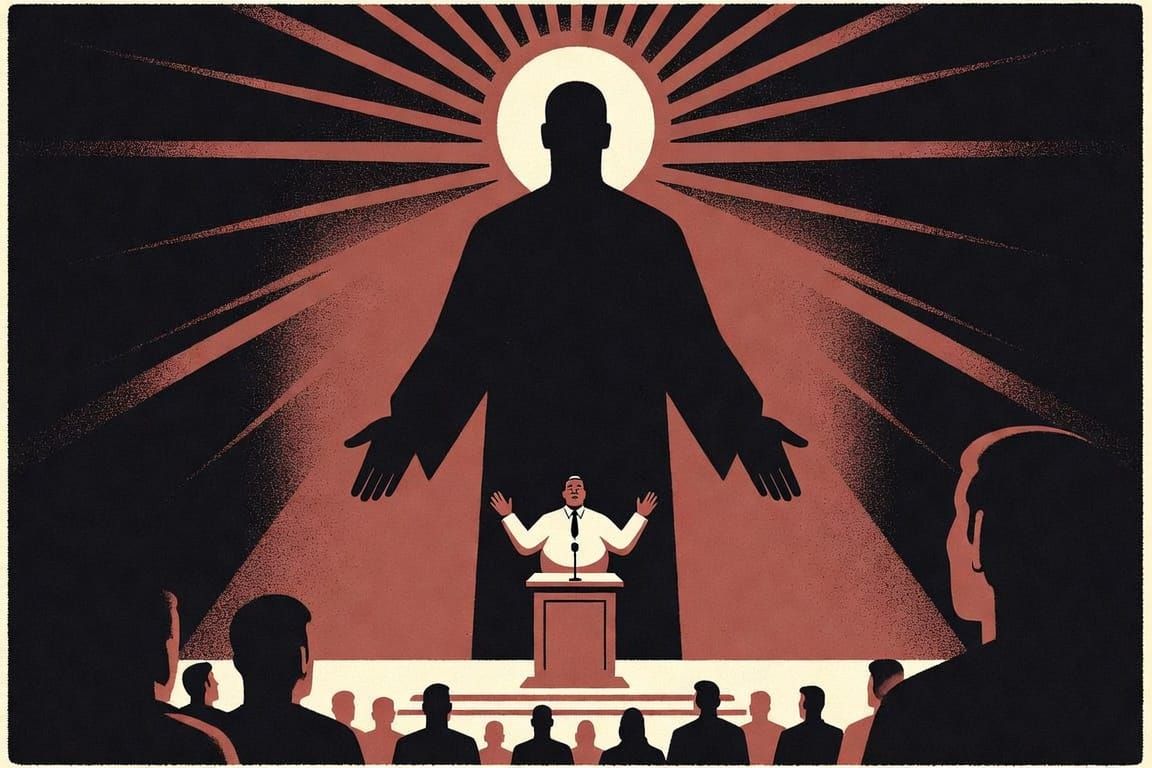
Her 2024 memoir Dinner for Vampires documents the whole decade, and the most instructive figure in it paints a damning picture of what I've previously dubbed "Buddy-Christ" Christianity, and the dangers that exist for anyone who falls into the orbit of the wrong pastor.
The popular image of a cult leader is a founder of his own religious body. Jim Jones built Peoples Temple. David Koresh inherited a sect and remade it in his image. Les, the pseudonym of Joy's cult leader, represents a more common yet less studied predator: the parasite who attaches to an existing body of believers. And the body he attached to was healthy, or looked healthy, right up until it wasn't. Understanding how he did it, and why it worked, tells us something uncomfortable about the brand of American Christianity that raised Lenz and millions of others.

Being Raised Right ≠ Protection
Early in the book, before any cult, before Les, Joy's father sits at her bedside and gives her the entire Christian faith in three sentences. Jesus never promised life would be easy. His own life and death prove it. But He promised to be present through all of it, and to give peace.
That's the offer, no matter what branch of Christianity you belong to. In this world you will have trouble, John 16:33. Take up your cross daily, Luke 9:23. Great is your reward in heaven, Matthew 5:12, and the location is the point. Paul goes further in 1 Corinthians 15:19: if our hope in Christ is for this life only, we are of all people most to be pitied.
The reward Jesus promised was always in the next life, always deferred, and the deferral is protective. A Christian who expects the payoff after death cannot be purchased with promises of payoff before it.
Joy's father understood this. And then mainstream charismatic evangelicalism taught his daughter something else entirely.
The Christianity Joy absorbed in New York and later LA was the prosperity-adjacent gospel of the 1980s and 90s, the theology of praise dolls and worship albums and Buddy Christ, the winking, thumbs-up savior that Kevin Smith's Dogma put on screen in 1999 as satire and half the American church adopted as a business plan.
Their core proposition is equally simple: If you surrender enough, pray enough, obey enough, then God will begin moving in your life, opening doors, confirming decisions with signs, making dreams come true. The more you sacrifice, the bigger the return.
Because Grace is something you can earn... right? Like a paycheck.
Joy absorbed that messaging whole, seemingly never bothering to fact check in the Bible or anywhere else. She also never took stock of her own finances, but we'll get to that later.
After falling in with the cult, she asked God to choose her outfits, on the theory that the man meant to be her husband might get a divine vision of what his wife would be wearing. Seriously. She read every audition callback as divine confirmation and every drought as a summons to sacrifice more. When her friend Mina fasted and prayed and then got engaged, Joy's honest reaction was to ask what Mina had sacrificed that she hadn't.
The problem with this theology, stated plainly, is once you define God as a supplier of outcomes, your evidence for God becomes your outcomes. And whoever controls your outcomes can impersonate God.
Joy's father had given her antibodies against this exact infection. She threw them away for the hope of a husband searching for a woman in a purple shirt.

How Les Got In
The Bible study existed for roughly a year before Les appeared. Two actor brothers, given the pseudonyms of Harker and Abe Van Hewitt, hosted about fifteen young entertainment-industry Christians in their North Hollywood living room every Saturday night. The format was standard evangelical fare: sing, read, discuss, pray, hug, go home. Their mother Pam mothered the young women. Their father Ed, a doctor, flew down from Idaho on weekends. Joy describes the group in its early phase as genuinely warm, a substitute community for transplants who'd left their churches behind.
Les, weirdly enough, was invited in. Like a vampire. Harker heard a recording of this small-town Washington pastor and felt the Lord speak through it. The family visited his church and soon Les and his wife and sons were guests at the Saturday study. On his first night, he delivered a testimony that should have alarmed everyone in the room.
Red flag number one: the persecuted pastor. Les told the group his beautiful church community was being destroyed by "the enemy." His congregation had "resisted growth." People "weren't ready" for the discomfort of healing. His family was losing the ministry home the church had provided. He was, in short, a suffering man of God, persecuted for his effectiveness.
Any mature Christian hearing this should ask the obvious question: Why were you fired and kicked out of the parsonage? What does the congregation say happened? A pastor thrown out by his own flock is either a prophet or a problem, and the odds overwhelmingly favor the latter. But nobody asked, because asking had already been framed as siding with the enemy—literally Satan. Les arrived pre-inoculated against scrutiny. And the sympathy paid out immediately: by the end of that first visit, Ed and Pam had given Les's family their Idaho house for a year, rent free, while they moved into the apartment above their own garage. One evening of testimony converted pity into real estate.
Red flag number two: the fabricated credentials. Les claimed six years as a decorated Marine sniper (E3, a Lance Corporal) so gifted he trained his own sergeants. If you have ever served in the Marines, or been in a Marine Corps family, you know how preposterous this is. He claimed to have co-pastored with Tim Keller, the late founding pastor of Redeemer Presbyterian in Manhattan, whose intellectual reputation gave the lie enormous weight with Joy as a young woman who'd attended Redeemer and revered Keller. Years later, Joy called Keller's office and learned the two men had once rented space in the same building. That was the entire association. Both lies were checkable in an afternoon. But checking requires suspicion, and suspicion had already been spiritualized into sin.
Red flag number three: the gradual, uninvited takeover. Les kept visiting Los Angeles. He adopted the same high-backed chair each week. Because he was older and held the title of pastor (supposedly), the group felt honored by his presence, and gradually he began reading the Scripture and kicking off the discussion. Joy writes that nobody noticed him absorbing Harker's and Abe's roles, and the brothers never objected. There was no vote, no conversation, no announcement. Authority simply migrated toward the man who assumed it. A church with even rudimentary governance would have caught this in a week. An unaffiliated Bible study in a living room had no such structure, and Les knew that before he walked through the door.
Joy missed every one of these red flags. She was 21 years old, recently transplanted to Los Angeles, a child of divorce shuffled between parents, lonely in a way she describes as having lasted her entire childhood. She wanted a family, and this group felt like one. Her theological framework, the one that replaced her father's, told her that feelings of belonging were signs from God. She felt she belonged, therefore God was in it. And the man who had orchestrated the feeling was already sitting in the high-backed chair.
How Les Targeted Joy
Here is where the book becomes genuinely difficult to read, because you can see the precision, and hear the regretful, embarrassed 20/20 hindsight in Joy's narration.
During a group prayer, Les asked everyone to stretch their hands toward Joy and delivered what the group understood as a prophetic word from God. He said he saw her in a pawn shop, telling herself she was second best, always the runner-up. She was to "come out of agreement" with that identity. Joy describes sobbing in front of the group, stunned that a near-stranger had named the wound she'd been carrying since childhood.
Lenz's own words: "His words hit my core wound with surgical precision. How did he know? How did he know?"
Girl...
He knew because she was a struggling young actress in Los Angeles who'd grown up poor, watched her parents divorce, and spent her childhood as the perpetual new kid. "You feel like you're second best" lands on that demographic with roughly the accuracy of "you have a complicated relationship with your mother." This is stock standard cold reading. Like those bullshit TV psychics from the 90s and early aughts. But Joy's framework had no category for a pastor running a mentalist's routine. She experienced it as God speaking through a man, and from that moment forward, Les held the keys to her emotional life.
He reinforced it constantly. He told the group she was "God's little princess." Pam, his chief enforcer, showered her with Disney Sleeping Beauty trinkets and notes about "entering a season of rest." Les named her independence as rebellion against God, her desire for a career as idolatry, her attachment to her actual parents as bondage to a "Jezebel spirit" of control. Every strength she possessed was reframed as a symptom of her rebellion toward God. Every boundary she tried to hold was diagnosed as a wall she'd built against God's love, which was delivered exclusively through Les and the group.
This is the same playbook Jodi Hildebrandt ran on Ruby Franke. Hildebrandt, the Utah life coach now serving time for child abuse, entered the Franke family as a counselor and within two years had separated Ruby from her husband, parents, and siblings. Any questioning of Hildebrandt's methods was framed as the questioner "living in distortion." Seven former patients told NBC News she methodically separated spouses. Kevin Franke told police the only way back into his own house was to get Jodi's approval, and it felt like an impossible task. Les operated the same way, on a longer timeline and with more people. Any doubt was a spiritual attack. Any outside voice, parents, coworkers, friends, was the enemy trying to pull you off the ship.
The difference between Hildebrandt and Les is that Hildebrandt got caught torturing children. Les got away with it because he tortured (and stole from) adults who had volunteered.

The Invented Language of Cultists
Les built a private language for the group that further cemented his control.
"Bio-family," a term heretofore used by adoptees, was instead used in the cult to demote your parents to a biological technicality. Your real Family, capital F, was the group. Once your mother is your bio-mom, ditching her for every major holiday and maybe just cutting her out of your life entirely doesn't feel like cruelty.
"Pressing in" meant accepting correction in a basement struggle session without resistance. "Unity" meant compliance with leadership, and the husband leadership picked for you. "Covenant" meant permanence, with exit defined as betrayal of a sacred oath. "Illegal questions" meant doubt itself was forbidden. And Les's masterpiece, the positive-speech doctrine, armed the group against the exact people trying to rescue them.
For the women specifically, there was the Jezebel doctrine. Les distributed booklets on the Jezebel spirit, an ancient demonic force of manipulation, seduction, and rebellion against authority, which he taught was passed down generationally through controlling women. Joy, descended from a line of formidable, independent women (her great-grandmother ran off to join the circus, her Nanny Marge rebuilt the family fortune twice), was invited to read her entire maternal inheritance as a curse to break. Female independence was akin to demonic possession. And instead of seeking guidance from her father, the patriarchal head of her spiritual life since she wasn't married, Joy was told that church leadership spoke for God. Therefore, it was only Les who could give her guidance. Les's authority that she had to submit to.
When a woman resisted in ways demonology couldn't cover, Les reached for psychiatry. He privately labeled Harker's wife Mina as bipolar when Harker's loyalty wavered. Years later, when Jasmine exposed Les's cover-up of her husband's infidelity, Joy's own husband repeated the identical diagnosis about Jasmine, word for word, on cue. A former leader from one of Les's earlier churches confirmed to Joy that the pattern predated all of them: women who didn't fall in line were always labeled bipolar or schizophrenic.
Struggle Sessions Aren't Just for Communists
The group's disciplinary mechanism was a meeting held in the basement of the Big House, and it is the scene in the book that will stay with you longest.
A member sat in a folding chair at the center of a hand-picked semicircle, candles lit by Pam to create a "cozy" atmosphere, and submitted to hours of loving dissection. For Joy's first basement meeting, Les instructed her beforehand to bring her private journal. She read aloud from it so the group could diagnose the self-focus in her entries. Three hours of childhood wounds, tied to current behaviors, delivered in kind tones by people who told her they loved her. When she cried and said she felt like she could never keep up, Pam stroked her knee and said, "Sweetheart, that's exactly the point. We can never live up to all the things God would require in His perfection."
And then Jasmine, the Stanford-caliber philosophy student who'd put her education on hold at Les's urging, began to say: "That's why we need Jes..."
Les cut her off before His holy name left her mouth.
"That's why we need each other," he said. "We're on this ship together. We're not gonna let you fall away."
That was his whole operation in a single interrupted sentence. The mediator between God and man, replaced by the group. The group, managed by its Papa. Joy had, without noticing the moment it happened, changed Les's name in her phone to "Papa" and joined a bastardized facsimile of Christianity.
Joy left that basement meeting grateful. That detail should alarm you more than a raised voice ever could, because the gratitude was the point. The meetings trained members to experience violation as investment. She sat up afterward on a beanbag chair writing furiously in her journal so she wouldn't forget "the truth" about herself. The truth she needed to document was the truth Les had just dictated to her.
Why She Stayed (And How She Got Out)
By the time Joy could see any of this clearly, she had given up Broadway, married Les's son at Les's direction (without being physically attracted to him or even liking his personality), moved her finances into a company Les controlled, refinanced her house for a restaurant Les wanted, cut off her parents, alienated her coworkers, and borne a child into the group.
The cost of admitting she'd been wrong was now the cost of admitting that every major decision of her adult life had been made under the influence of a con artist. That's a price almost nobody can pay while they're still inside. She stayed because the alternative, facing the full scope of the damage, was more terrifying than enduring more of it.
It's worth noticing who escaped first and how. Harker, the man who'd first heard Les's sermon tape and inadvertently let the parasite in, got out by reading church history. The early councils, the schism of 1054, apostolic succession, the boring institutional scaffolding that experience-driven evangelicalism dismisses as dead religion.
He and Mina left for Orthodoxy with a letter asking only that the Family investigate before judging. The route out was doctrine: the one thing Les's theology of feelings had no defense against. If you actually know what Christianity has taught for two thousand years, Les's innovations are obvious counterfeits. Harker's exit proved that the best protection against a fake gospel is familiarity with the real one.
Joy's own exit was slower and uglier. It ran through a bank balance that showed $220,000 where $2.4 million should have been. She had a moment that every Buddy-Christ Christian has where she screamed obscenities at God and cursed the genie who never paid out. Because, if God, why bad things happen?
It's not fully clear if Joy moved away from the childish, wish-giving version of the Lord of Hosts, or if she just looks at her beautiful daughter and labels her as the good God gave her to get her through her trials. I'm genuinely not sure.
Every church that preaches God as the guarantor of your breakthrough is running the same con Les was. The pastor may be sincere, interpreting the scripture as obedience buying outcomes and feeling empowered to broker that exchange for his flock. But he's wrong.
Two thousand years ago, the offer on the table was a cross now and a crown later. You, humble man or woman, don't necessarily deserve the cross you have to bear. And none of us deserve the crown gifted to us by a God beyond our understanding.
Anyone telling you otherwise is selling something.
Free subscribers get weekly essays on morality, culture, and character through fiction. Paid subscribers get everything.


Member discussion