

paid only
Forgive Him. No Matter What?
This article will NOT be discussing conspiracy theories regarding the murder of Charlie Kirk
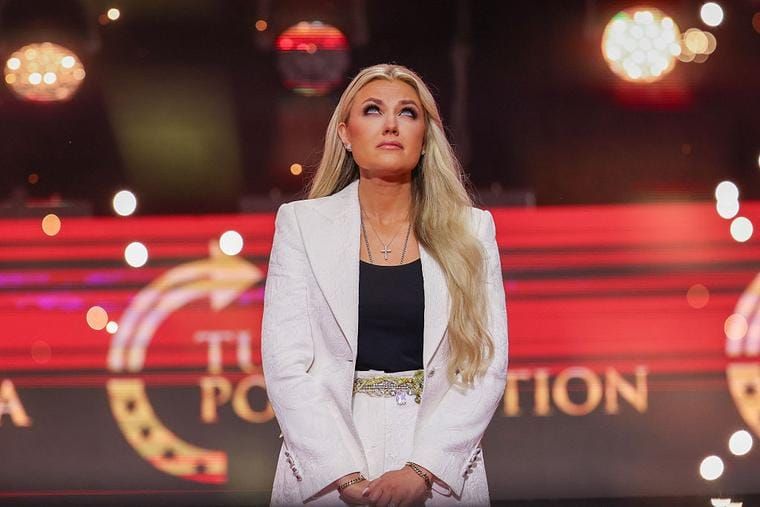
I didn't know Erika Kirk's name until the day of her husband's memorial. I'd never seen her face and I couldn't have told you a single thing about her.
But when she walked out on the stage under a hail of sparkly pyros (for some reason), I knew exactly what she was going to say.
I knew she would speak warmly about her husband and what he meant to people. Of course. That's why we were all here. But then there would come the line. I knew she would say it. And I even knew how. I knew there would be a pause, a deep breath, her big blue eyes looking skyward, silently asking God for strength, and what came after it would be some version of I forgive him.
On September 21, 2025, in front of tens of thousands of people, she stood up and quoted Christ from the cross asking the Father to forgive the men who put him there. Then she said of the man charged with murdering her husband, "That young man. I forgive him." The stadium came to its feet. Every conservative pundit praised her, many with tears in their eyes.
She'd said her line. She'd done her duty. There was literally no other acceptable thing for her to say.
And no, it wasn't because she was the wife of a public figure, a man who very well may have been president one day. It was only because she was a Christian.
Forgiveness Taken Rather Than Given
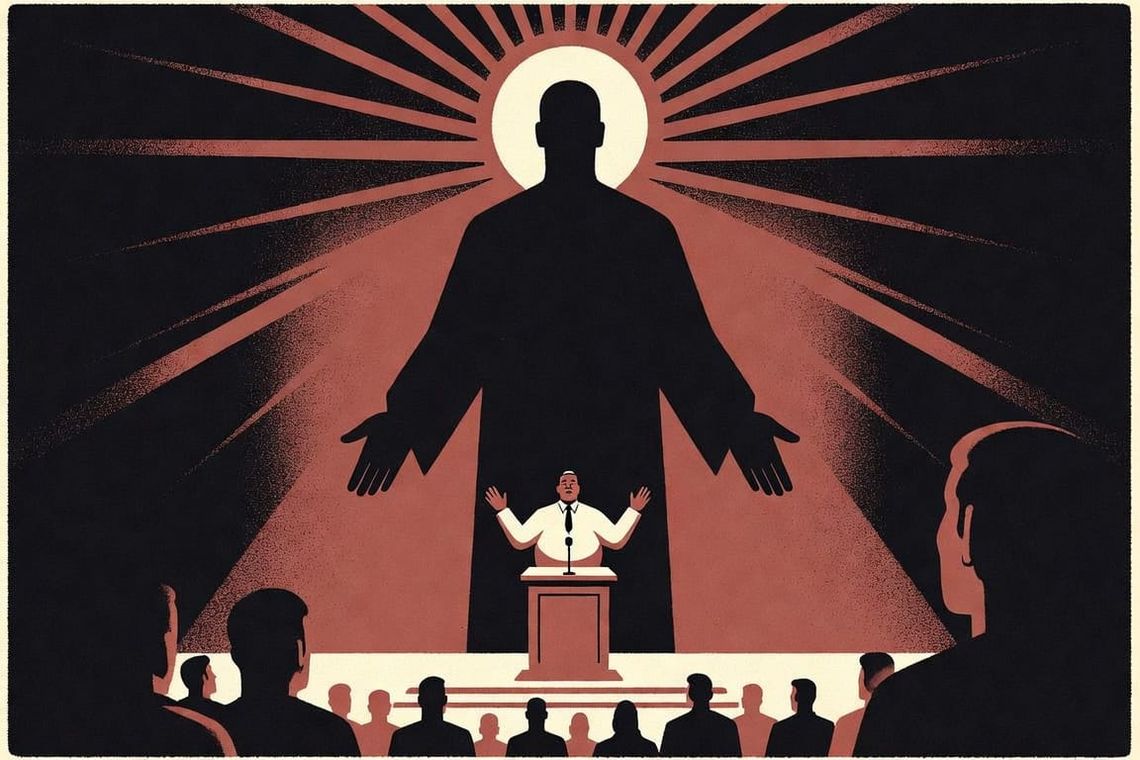
My video coming out on Tuesday is a deep dive into forgiveness, as demonstrated through Negan from The Walking Dead. I chose that example specifically because it showed the full cycle of contrition, repentance, and absolution. That journey is important to show because Big Eva and Megachurch culture (which I not-at-all affectionately refer to as Buddy-Christ Christianity) has warped the Christian teaching of forgiveness. And, in my opinion, it has turned followers of Christ into suckers.
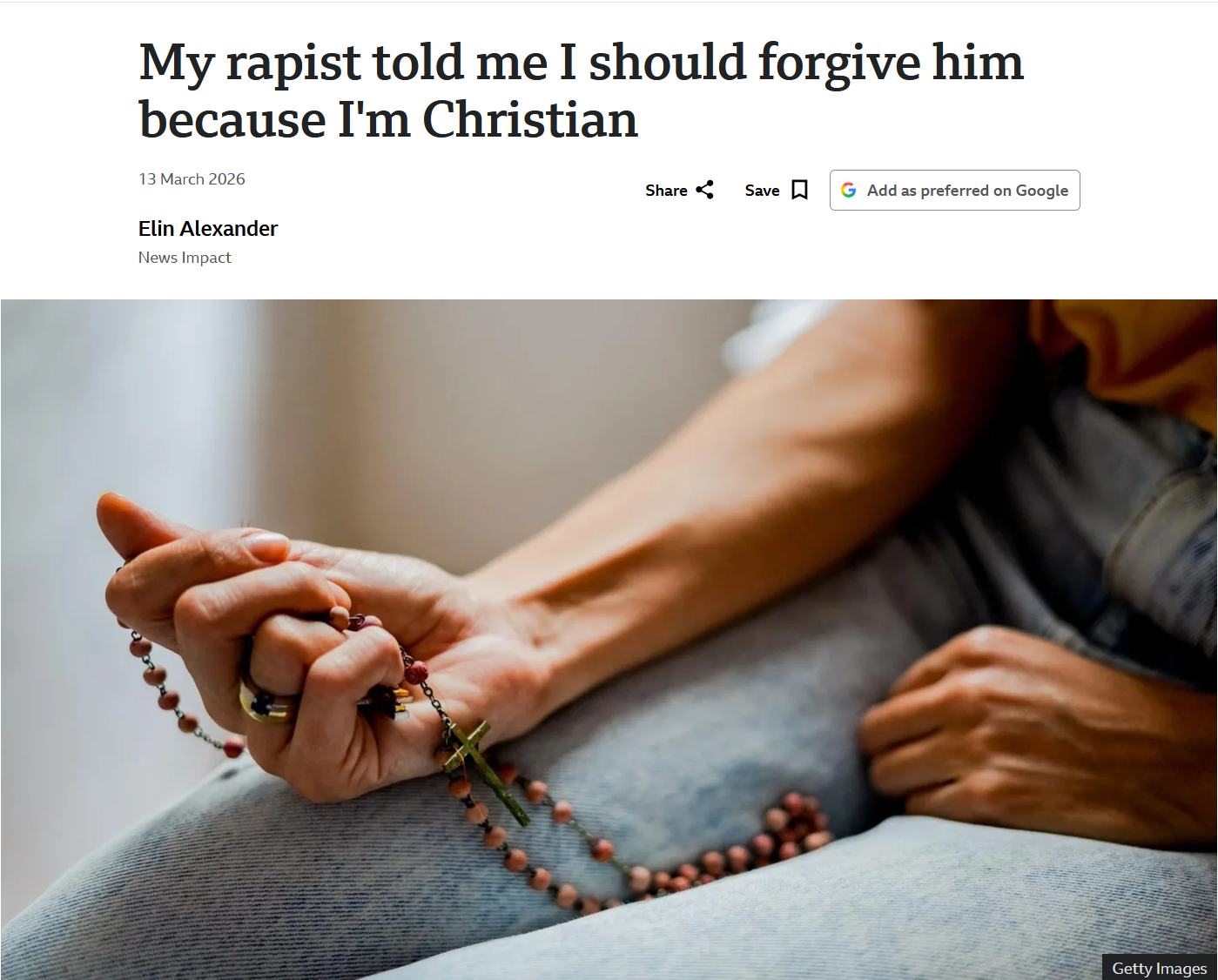
A woman in south Wales, calling herself Grace because using her real name would put her in danger, told BBC News what it looks like when somebody weaponizes a Christian's faith.
Grace went through domestic violence for over a year, including being raped. And her attacker did what a lot of psychopaths like to do.
He came to church with her the next day and said he was sorry in front of the altar, and she thought that apologizing in front of God had to count for something.
It didn't count for anything. It was just something he did to get her to drop the charges and make himself look like the good guy.
"Come on love, forgiveness. Isn't that what you people preach?"
And it's not just abusers who pull this crap. There are well-meaning people (both Christian and not) who frame forgiving others as the best thing you can do for yourself. You are the one to give the forgiveness and you are the one who benefits.
“Forgiveness doesn’t make the other person right, it makes you free.”- Stormie Omartian
“Forgiveness is the key that unlocks the door of resentment and the handcuffs of hatred. It is a power that breaks the chains of bitterness and the shackles of selfishness.” — Corrie Ten Boom
And yes, letting go of anger has benefits. Anger is draining. Dwelling in a sense of victimhood is, without question, bad for you.
But that comes only AFTER the wrong-doer has been dealt with as much as is humanly possible. That's the part that the biggest voices in American Christianity seem to leave out. And you have to wonder why.
The Thief Stays on the Cross
The thing about Erika Kirk's display of forgiveness is that her husband's accused murderer had not (and to this day has not) expressed one iota of remorse. All his behavior before the murder and after showed a premeditated killer who was delighted at what he'd done. The little shit's behavior during his trial only cements that.
Why are you forgiving "that young man" when he's not sorry and, by all appearances, would happily do the same thing again to any number of public conservative figures? Who told you that was your job? Your parents. Your pastor, probably. Almost certainly your late husband.
And they were ALL wrong.
Because it isn't even a staple of Christian theology. Not Catholic or Protestant.
The older Reformed and Catholic traditions both understood forgiveness as a two-party transaction conditioned on repentance. Calvin, Luther, and Cranmer all held that God's forgiveness requires faith and repentance from the sinner. The Catholic sacrament of confession builds the same sequence into its structure: you confess, you receive penance, then you're absolved. Hell, sinners used to don ashes and sackcloth and crawl on their hands and knees to demonstrate their contrition.
The idea that a victim owes automatic, unilateral forgiveness to an unrepentant offender would have been foreign to the Reformers and to the early church fathers.
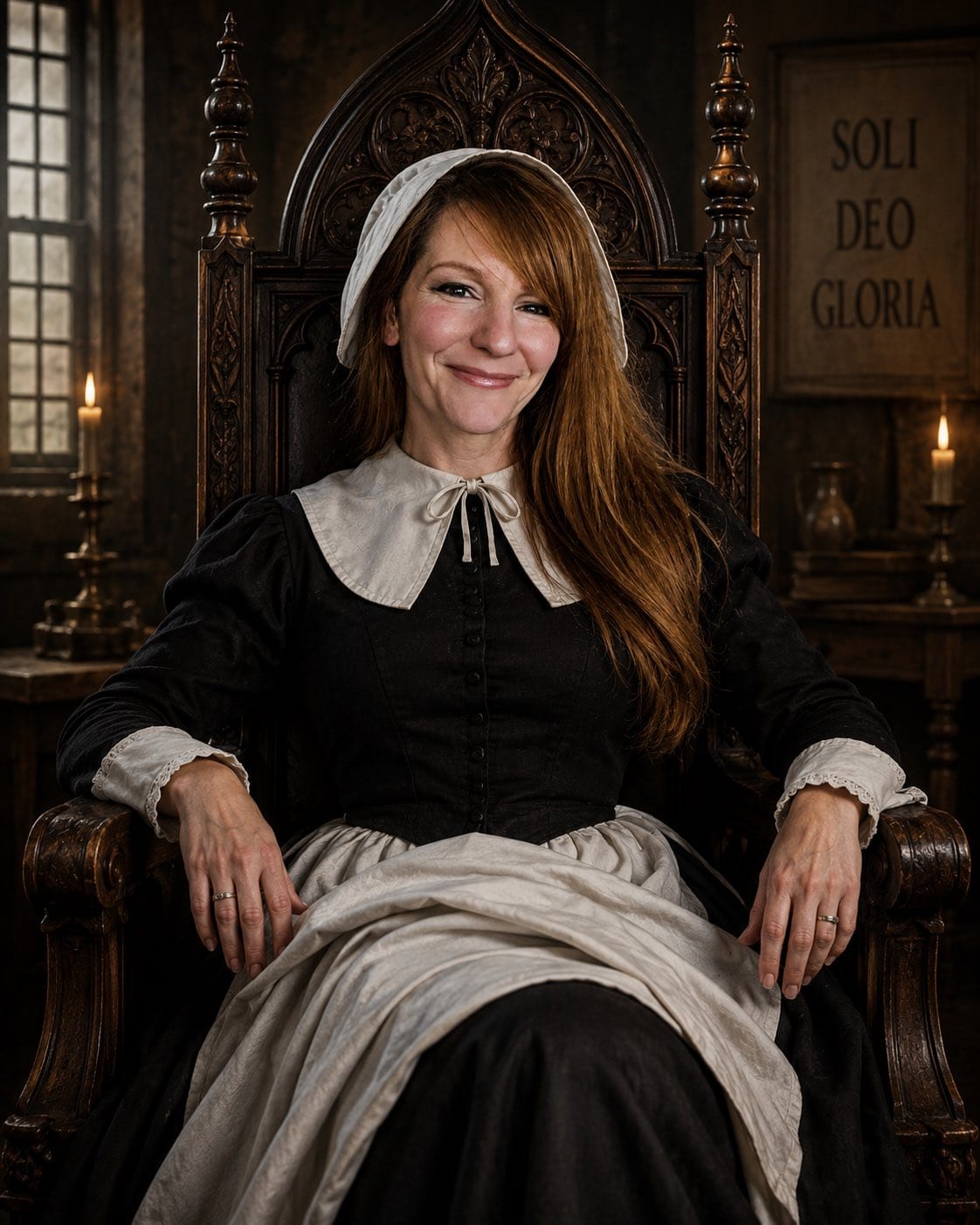
The shift happened when American evangelicalism absorbed the therapeutic culture of the 1970s and '80s. Forgiveness got reframed from a transaction between two parties (offender repents, victim releases the debt) into a one-party psychological act the victim performs for her own emotional benefit, regardless of what the offender has or hasn't done.
The landmark text is Lewis Smedes' Forgive and Forget: Healing the Hurts We Don't Deserve (1984). Smedes was a Reformed theologian at Fuller Seminary, which makes the irony especially sharp: a man from the tradition that insisted forgiveness is conditional wrote the book that taught a generation of evangelicals it's unconditional.
Kevin DeYoung at The Gospel Coalition and Chris Brauns (who wrote Unpacking Forgiveness specifically to push back against this) both name Smedes and pop psychology as the source of what Brauns calls "therapeutic forgiveness": a unilateral, internal effort to get your emotions under control, disconnected from any requirement that the offender repent or make restitution.
Dennis Prager wrote in the Wall Street Journal that he was "appalled and frightened by this feel-good doctrine of automatic forgiveness." Maria Mayo's The Limits of Forgiveness (2015) traced how unconditional forgiveness became "presented as a Christian and Christlike obligation, putting disproportionate pressure on the victims of injustice or violence."
So the timeline runs roughly:
- pre-1970s, the dominant tradition (both Reformed and Catholic) held forgiveness as conditional on repentance.
- 1970s-80s, the self-help and therapeutic movement enters the church, and forgiveness gets repackaged as something the victim does for herself.
- 1984, Smedes codifies it in a bestseller.
- 1990s-2000s, it becomes the default pastoral response to everything from marital infidelity to child sexual abuse, producing the compulsory forgiveness culture.
Erika Kirk was born in 1988. Poor girl never had a chance. And neither did most of the Gen X and Millennials raised in the various American Protestant denominations.
What Extracted Forgiveness Costs
Grace got a conviction for her abuser. He was sentenced to nine years for what he put her through. Fabulous. However, she got eight weeks living between her car and hotel rooms, a lost job, a lost house, and a period when she thought about ending her life.
She's still a believer, which doesn't surprise me. She says she's closer to God now than she was before and has tried a few different congregations. But the church she'd called home, the one where she brought him, where he stood at the altar and performed his remorse... she couldn't go there anymore. Because she still feels shame for what was done to her. As if all this was her fault.
And the doctrine that made her such easy prey is still being preached. A few days ago, a clip of Pastor Steven Anderson went viral on X. Anderson runs Faithful Word Baptist Church out of Phoenix. He's been banned from thirty-four countries. In the clip, he tells his flock that if your husband slaps you down and you call the cops, you're evil. An evil broad. An evil woman. He also condemned wives who use cameras or recorders to document instances of their husband beating them or raping them.
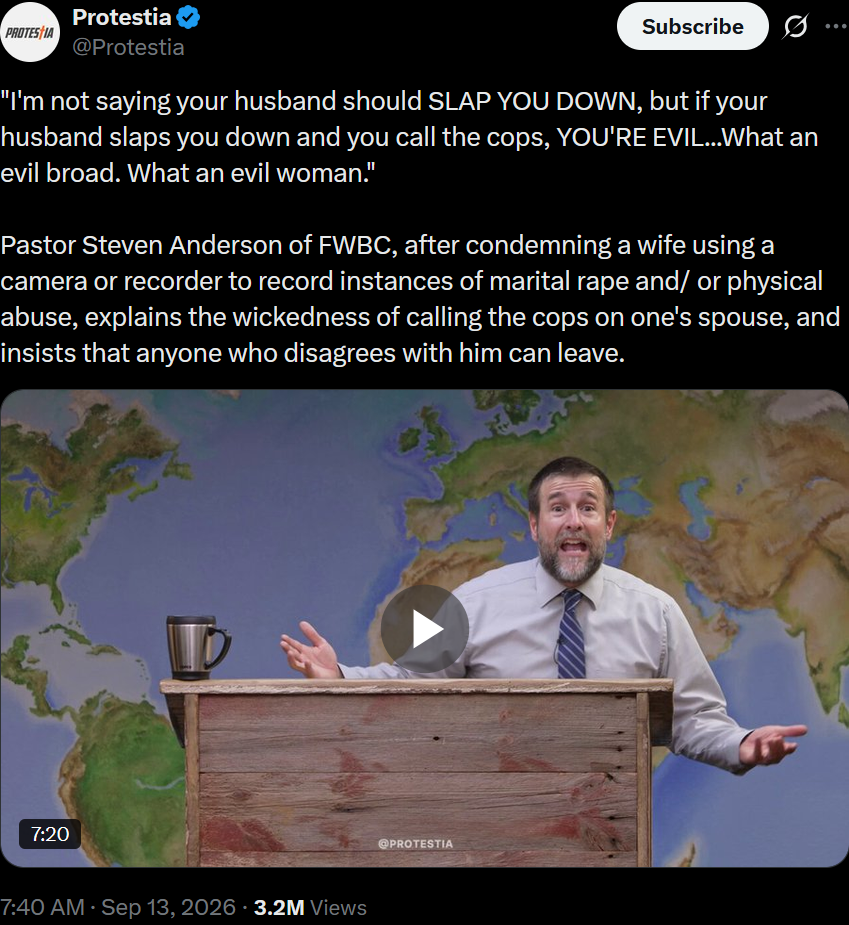
His four oldest children recently came forward alleging years of domestic violence against their mother and physical abuse against themselves. His son told Protestia that Anderson used the same electrical cord on their mother that he used on the children. His daughter said she remembers praying as a little girl that God would kill her.
To be clear, this guy is a lunatic. An extremist. He is not representative of American Evangelicalism. But he is taking the doctrine of instant forgiveness to its logical conclusion. If marriage vows, or being this man's child, or being in his congregation, forever obligates you to take whatever he dishes out, forgiving instantly even if he doesn't ask for it, then it's not actually much different than what Erika Kirk felt obligated to do on that stage.
I have no idea whether she meant what she said. Neither do you. She may be a woman of rare and genuine grace who spoke a true thing on the worst day of her life, and if so, God bless her and I hope she's at peace.
But I don't think she did mean it. I think she–a former beauty queen and a polished public speaker–knew her lines and she delivered them for the audience.
If you haven't picked up on it yet, I don't agree with that. And neither does Christian doctrine. I don't expect other Christians to go through life as the kind of barn burner I am. But I do expect them to represent their faith responsibly if they use it as a public platform.
It is not your job to keep the peace in your family or your church community by publicly forgiving your wrongdoer.
It is not incumbent upon you to move on based on other people's timeline. And it's definitely not on you to extend grace to an observably unrepentant evil-doer. And I have no patience for any pastor or Christian influencer who says otherwise.
You are in error, sir or ma'am. You are wrong. And for that, you should repent.
Written by

Join Us
Free subscribers get weekly essays on morality, culture, and character through fiction. Paid subscribers get everything.








Member discussion