You already know the answer. The cowardice is in pretending you don't.
Maybe you've heard there's a new adaptation of Little House on the Prairie on Netflix, wherein Pa Ingalls has the most shampoo-commercial hair I've ever seen. Of course the books and the 1970s tv adaptation are beloved classics, so the series has been met with some skepticism.
But nothing could have prepared me for the review by Sarah Moss, a columnist for The Irish Times, who confessed unprovoked that she found it hard not to feel, on behalf of energetic plain girls everywhere, that there was "some justice" in pretty, good girl Mary going blind after measles.
... I beg your finest pardon?
This is a former professor of nineteenth-century literature, writing under her own byline in a national newspaper, confessing that she felt satisfaction in a (very real) child losing her sight because the child was attractive.
What I find interesting in this piece is that the author makes a moral argument against the politics of Little House on the Prairie while simultaneously admitting she felt a sadistic level of ‘justice’ in a character going blind because she is pretty. pic.twitter.com/3tvqxzDOal
— Rachel Moiselle (@RachelMoiselle) July 13, 2026
Obviously, I don't read the Irish Times so I saw this odious article thanks to Rachel Moiselle, a conservative commentator, who shared the article and highlighted the passage about Mary.
More interesting even than the post was one of the comments. Another user, going by Orion, posted a photo of Moss with the caption "Intrasexual competition is wild." And Moss looked exactly the way you'd expect a woman who resents another woman's beauty (or in this case, a girl) for being pretty to look. Everybody who saw it recognized it instantly, which is the whole problem.
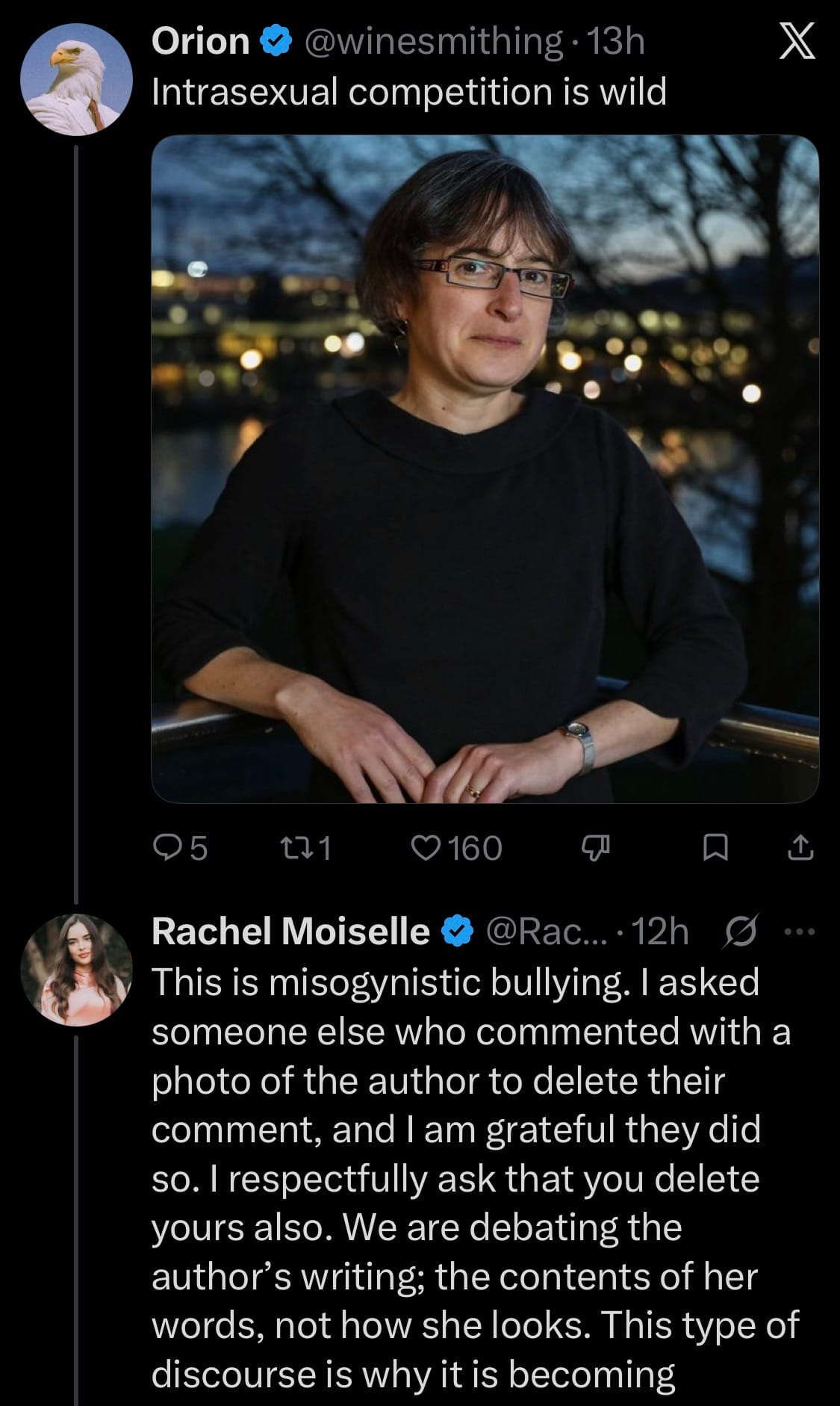
Rachel was furious. She called the photo misogynistic bullying and asked Orion to take it down. As of this writing he has not, which I am glad of. Because his point is correct. Moss looks like the woman who is unkind to pretty girls and wishes harm upon them, and likely feels justified in those feelings. Why else would she so boldly put them in print?
And yet Rachel didn't even want to see that comment, let alone consider its merits. She instead held the seemingly respectable position that it was necessary to comment only on the contents of Moss's words, and that her outward appearance was entirely irrelevant. Only a spiteful misogynist would link Moss's appearance to her inner nastiness, apparently.
The problem is that Rachel (and many other good-hearted people) will often invoke this principle and reject the obvious truth that yes, actually, you often can judge a book by its cover. And you should.
Feigning Blindness
I'm hardly the first to observe that how people live shows up in how they look. Writers have been saying this for over a century, and they keep saying it because it keeps being true.
George Orwell wrote the last line in his personal notebook in 1948: "At 50, everyone has the face he deserves." He died eighteen months later at 46, just short of his own deadline. And frankly, who you are shows up on your face long before 50.
Roald Dahl told children the same thing in 1980, in The Twits, a classic that I'm happy to say has been doing the rounds on social media. Dahl was writing for eight-year-olds, or at least that's how old I was when I read The Twits, and eight-year-old me understood him perfectly, because eight-year-olds haven't yet learned to pretend they can't see what's in front of them.

Oscar Wilde built an entire novel around the consequences of escaping this principle. In The Picture of Dorian Gray, the portrait absorbs the visible record of Dorian's sins so that his actual face stays young and beautiful. The horror of the story depends entirely on the reader understanding that this arrangement is an aberration, that under normal circumstances your conduct (and your personality) shows up on your body, in real time, for everyone to see.
The funny thing is that most people don't flinch at these literary references. But somehow, when you point to an obese person, a woman with dyed bright hair or facial piercings, or a dowdy, frowning woman with a mouth puckered up like a cat's ass, you're being "mean" or "judgmental" if you prognosticate about their character, personality, or politics.
It's an annoying defense mechanism. People decry judging others' appearance and lump together immutable characteristics or deformities with fashion choices and lifestyle indicators.
I'm so sorry, but speculating on a man's character because he has a cleft palate is not the same thing as guessing your neighbor's politics because she doesn't shave her armpits and she introduces herself as Lilith (even though her real name is Diane).
Nobody earns their bone structure, of course. And nobody deserves contempt for what genetics dealt them. If the claim here were "ugly people have ugly souls," the claim would be garbage and would deserve every bit of pushback it gets.
What people actually mean when they say "why do they always look like that" is entirely about choices and mindset. The way you think about yourself and the world around you shows up in your face, your posture, and your styling. All of these things give signals to those who can see you: how you carry yourself, the aesthetic you choose, the grooming you do or don't invest in, the visible signals you send about which tribe you belong to. And those choices tell the truth about your priorities and your worldview with a consistency that most people find uncomfortable to acknowledge out loud.
No one likes to acknowledge how predictable other people are, because then they might have to admit they are predictable too. We all like to think we're special unique snowflakes that no one really understands, but it isn't true.
Just think of any time you met a new person and they informed you that they were a vegan, and your immediate response was, "I know."
A TikTok creator named Andrew got over six million views last year asking a single question: "Why do people in open relationships always look like that? I'm being very non-specific here, but you know what I'm talking about." He didn't have to be specific. The comments filled in the picture instantly because everybody already had it in their heads. One polyamorous woman stitched his video and admitted he was basically spot on. She wasn't offended. She recognized that a shared lifestyle produces a shared aesthetic, and that other people can see the aesthetic whether the people inside it want them to or not.
This past week, a Denver chapter of the Democratic Socialists of America posted a photo of a packed meeting room celebrating a local primary win. Over half the attendees were wearing Covid masks in July of 2026. The poster deleted the image after it went viral for the wrong reasonsWhy'd you delete it bro? Was it because you realized that this group of dysgenic weirdos sent the wrong message about what kind of people identify as Socialists? Even in a still photograph, we can see who you are based on the choices you make. Choices reveal character. And the rest of us can read them.

Forty is NOT the New Twenty
Refusing to notice reality usually gets marketed as a form of kindness thing to do, but sometimes it's also framed as a bold declaration, as if you and your pantsuit feminism are bending reality itself to your will.
Remember "I don't see race" and how we were all supposed to say it because if you didn't, you were racist? And the BLM folks came and said actually, saying it means you ARE racist. Yeah that was fun.
"All women are beautiful" is still making the rounds, even though it's just an embarrassing admission that you care more about the social cost of having an opinion than you do about truth.
"Age is just a number" is fodder for delusional divorcees preying on girls their youngest son's age and for insecure cougars still trying to run the same race as the TikTok girlie pops. These people refuse to acknowledge that aging is real, that it changes the body and the face, and their pretense is an insult to everyone who has to live honestly inside a body that shows its age whether you "feel" it or not.
These phrases exist to make the speaker feel virtuous. They do nothing for the people they're supposedly about. And they all share the same underlying function: they give the speaker permission to stop looking at what's actually in front of them, which is the first requirement of moral seriousness. You have to be willing to see what's there before you can respond to it honestly.
We All Do It
Lest I appear to be finger wagging, let me confess my own shameful defense mechanisms.
I saw a Substack note this week from a writer I don't follow: "No one hates young women more than middle aged and older women." I read it and every cell in my 44-year-old body wanted to fire back with something cutting. I had it composed in my head within seconds, something like, "Oh yes, because when a young woman is murdered, the police always suspect the nearest middle-aged woman."

It was sharp and funny and completely disingenuous, because Natalia wasn't talking about violence. She was talking about the passive-aggressive sabotage, the cutting remarks, the intrasexual competitive behavior that older women sometimes aim at younger ones. She was naming a pattern, one I have seen many times myself, and yet my first reaction was to yell at her for it.
I didn't post the comment. If age has brought me anything, it's self awareness. The reason for my knee-jerk anger is obvious and embarrassing. I'm 44, and the physical evidence of aging is becoming harder to ignore with every passing season. Actually, perimenopause snuck up behind me this summer and beat me over the head with a shovel. So I didn't like being lumped into a group that supposedly hates young women... that group I used to be in.
That reaction is exactly the mechanism this entire essay is about. I noticed the pattern. The pattern implicated me, or at least women who share my demographic, and my first instinct was to argue with the framing. The snotty comment I almost posted would have used humor to avoid the honest, uncomfortable acknowledgment that Natalia saw something true and I wished she hadn't said it where I could hear it.
All The Ways We Lie
The refusal to see patterns is an act of pride, one of the aptly named deadly sins. That pride takes one of two forms: the pride in oneself ("I'm a middle-aged woman; your assertion that we engage in sabotage of younger women is a lie!") or the pride in one's status ("I'm a good and righteous person, so I insist there is no difference between that 300-lb man with a bald spot and the professional basketball player beside him. No difference at all! See how good I am? I'm better than all you judgemental people!")
It's hard to pick the deadliest of the seven, but pride is behind more human suffering than any of the others because pride is the sin that lets you reclassify all your other sins as virtues.
Are we wrong to notice that people tend to look exactly the way their choices would predict? No, we're not. Of course we're not wrong. Every person who's ever looked at a group photo and thought "yeah, that tracks" has noticed. We all notice.
The cowardice (and sinful pride) is in pretending you don't. And the morality of any given moment comes down to what you do after you've seen what's there. You can demand that other people stop saying what they see to make yourself feel better. Or you can do the unglamorous, ongoing, deeply annoying work of acknowledging the pattern, acknowledging your place in it, and maybe, change course on your own choices to steer out of the skid.
The face you'll have at fifty depends on which of those you practice most.
Free subscribers get weekly essays on morality, culture, and character through fiction. Paid subscribers get everything.
Member discussion