
We Are All Depraved: How Christians Changed My Faith

This is a recitation of my personal morality and how it led me to a specific theology. I am not a salesman, and you are not my mark. So this is not an attempt at persuasion or conversion, only an explanation of my own point of view.
Thanks to my recent essay and video on forgiveness, I've gotten a lot of pointed questions about my faith. Both atheists and Christians want to know my specific brand of Christianity so they can more effectively tell me why I'm wrong. My upcoming video is on the movie Frailty, which has a lot of religious assertions, so I'm sure more of the same is incoming.
In light of that, I thought I would write a full statement of what I believe and what my non-negotiables are. The sad part is that such a full recitation is almost required. Because saying "I'm a Christian" isn't actually that clarifying, given that there are no fewer than 45 thousand denominations of it.
And for whatever reason, people also call themselves Christians when they actually aren't.
I see it frequently in the online slap fights between cradle Catholics and the (admittedly) zealot newly-converted Catholics. The new converts actually know what the Catholic Church teaches, and how it's different from being a Protestant, or an Eastern Orthodox. The cradle Catholics don't. Or if they do know, they don't care.
Because being Catholic is their team. Something they identify as without believing any of the very specific tenets of that church.
"No, the host is not the actual body of Christ. Yes, I have sex with many people I'm not married to and don't feel bad. God knows my heart. I don't need confession. Neither do you. There are many ways to heaven. All religions are equal. Yes, I'm Catholic and don't you dare say I'm not!"
These are exact claims I've heard from professing Catholics and they will never cease to baffle me. They've just described the Unitarian Universalist church down to the last comma, yet they'll fight you in a parking lot if you meekly suggest they're going to the wrong church every Sunday.
Why? Why do this? You live in a country where you're free to live as your conscience dictates. Nobody is going to jail you. So why go on describing yourself as a member of a religion whose central tenets you reject?
Having been raised Catholic myself (and spent many years debating being a nun) I understand the impulse better than I'd like to admit. I love the Catholic mass. The vestments. The tradition. And I love the people. I vibe with cradle Catholics much better than a lot of Protestants, and I suspect I always will. It's my culture. It will always be my culture.
But it isn't my theology. And it never was. So hard as it was to admit, I cannot be Catholic. And once I admitted that to myself, I had to figure out what I actually was. Which meant I had to start doing the thing I'd been avoiding since I was fifteen.
I had to start asking questions.
I discerned religious life from about fifteen to nineteen. That's a polite way of saying I spent four years planning to become a nun.
It was always at the back of mind, even at the beginning of my Marine Corps enlistment. But by the end of my enlistment, I knew the convent was out. And by the end of college, I knew Catholicism was out too. That left me out in the cold. If the only "correct" Christianity wasn't something I believed in, then where did that leave me?
I had no answer, thus spending decades knowing only what I wasn't. Which is a spectacularly useless thing to know about yourself.
Why I didn’t become a nun
Discernment and how you serve
 Kristin McTiernan
Talking to other people didn't help much either. Somewhere in the last fifty years, American Christians decided that denominations are basically flavors of the same thing, and that asking about the differences between them is rude, like asking a coworker what she paid for her house.
Except the differences between denominations are actually really important. They have competing claims about what God is, what a human being is, and what happens to you when you die. They contradict each other and thus some of them have to be wrong. And I had no interest in playing along with something demonstrably wrong out of politeness.
To find out where I actually stood, I decided to embrace Millennial entitlement. As a Gen Y/Elder Millennial, I don't often fit the stereotypes of my cohort. But just this once, I gave in. I got an expensive coffee prepared by a heavily pierced They/Them, and I wrote out my list of demands for a church I could belong to.
The Non-Negotiables of My Faith
- Recognizing the unknowability of the Almighty (by the human mind)
I will not suffer a church leader who presumes to divine God's intentions. No, Pastor Dan, I don't think my uncle died of prostate cancer for a good reason. Nor do I think I got this job because I am uniquely anointed. Making God out to be your personal wish-granting genie or your neighbor's malevolent punisher is a no-go. Churches like this are why we have Christians deconstructing in their 20s and asking "If God, why bad things happen?" He is unfathomable to us, and He left us a lengthy set of dumbed-down instructions so we might, to our best ability, know Him. The word is sufficient.
- A focus on truth of the tenets of the faith, not on eliciting emotional responses from the congregation.
Mega church concert services always rubbed me wrong. Hearing girls describe their emotions as they are listening to a worship song, their eyes closed and hands raised, was always a recitation of how I felt in the pit at a Korn concert. Adrenaline, then dopamine. Fellowship with the ones in the pit with you, experiencing the same thing you're experiencing. That's just music. Which comes from the Lord, yes. But it's not a reason to choose a religion, and it doesn't teach you about God or how to live your life in obedience to His word.
- Humans are bad. All of us.
A lot of atheists like to use the idea of hell or even judgment as some kind of a gotcha during religious debates. Since love and "niceness" has been the brand of American Christianity for a long time, they love to pull this one out. "So you're saying I should go to hell? That I deserve to burn for all eternity? That's not very loving!"
It's not a gotcha for me. "Yes, you deserve to roast in hell for all eternity. And I deserve to burn right along with you."
It doesn't matter what particular sin we're discussing. Maybe it's one I've personally committed. Or maybe not. But there are myriad others I have committed. Was this one sin of the atheist's somehow more damnable than mine? Nope. We both are filthy in our respective sins, with the only hope of being made clean in the blood of Christ, shed for us, quite undeservedly.
The absolute depravity rule was strangely the thing I found most attractive, because the alternative, the insistence that I am somehow special, has always struck me as manipulative. Why are you insisting I have some special quality that only God can see? I know what special means. And I'm not special. Some people are. By virtue of being special, they are by definition RARE. So how can we all be special?
We can't. This is the very human drive to elevate ourselves, to worship ourselves. Follow ME because I'm better than that person, or that group of people. Total depravity rejects this. The fact you didn't commit that particular sin doesn't make you better. You committed that other sin, and the fact no one saw you do it doesn't improve your case. The fact that you had different circumstances that didn't lead you to that sin doesn't mean you wouldn't commit it under those same circumstances. You would. You just don't know it. But God does.
The religion that best guards against sinful pride, the deadliest sin, is the best one. I believe that completely.
- Christ didn't die for all humans. He died for some.
This is observably true to me and I think a lot of other people too. We just don't like to say it out loud. But it doesn't take much looking around to understand we are not all the same. We are not equally loved. We're not equally imbued with the goodness of God. You can see that with your own eyes, which is why people love to ask "Could Hitler be in heaven?" That's the safe way to ponder universal salvation. Here's a less safe way, and forgive me for the nastiness of this example. In Africa, there are men who admit on camera to raping literal infants. They do this because they believe it will cure their AIDS. They say this straight faced and when asked about the baby, the men just shrug. "Yes, it's a bit of an inconvenience, how they scream. And then some of them die. But you can always make another one." Not only are they not sorry, they don't understand why other people think they should be. And when they realize that their AIDS is still present, it's entirely likely they'll do it again.
This is a human? This thing has a soul? And just needs some education and a communion wafer to make him the same as the best person you know? Sorry, I don't buy it. I think people insist on universal salvation because they want to be the one saved.
But we can't know who is on the list. Even if all outward appearances check out. We, mere humans, can only see what's in front of us. In the past, and right now. We can't see the future. We can't see inside someone's heart and mind. Which is why we can't point a finger and declare who is among the elect. We can have an evidence structure for who we want to associate with, who is best to have around to build the kind of society and fellowship God commands. But we, mere men, cannot know who is elect and who is reprobate. But the distinction exists. I will not be convinced otherwise.
- Humans are permitted to defend their lives and property. Nations are allowed to defend their borders. Compelled charity (wealth confiscation and redistribution) is sin. And tyranny. Suicidal pacifism is not of God, and I will follow no religion that encourages one group to give up their way of life for the benefit of another.
- The time of prophecy is ended and God no longer speaks directly to humans or sends his angels to directly interfere in human affairs.
I am firmly cessationist. Anyone claiming to hear from God personally is either mentally ill and needs treatment immediately or is evil. That's it. That's all. I will follow no religion that declares otherwise.

- Jesus is the only human who lived without sin. He could only do this because He is God.
Asserting that it's possible for other humans to live without sin (yes, even mother Mary) is heresy. Jesus being sinless (because He is God) is why only He could be the sufficient sacrifice to wipe away the sins of the elect, to make Grace possible. There is no free lunch, certainly not in the face of human depravity and the perfection of God. A price must be paid for all things and no human bearing the weight of original sin could pay it. To deny the sinlessness of Jesus or to assert it was not unique unto Him is to deny the blood price of Grace. I will attend no church that makes such a denial.
- The best religion is the one that works with the knowledge we have and understands human nature as it exists, not as our ego would like it to be.
We have centuries of scholarship. Going off vibes is not acceptable. That's why there are words for concepts like Pelagianism. We hear that and we don't know what it means. It feels inaccessible. But the word exists to describe a long-debated and long-rejected heresy, that all people are born as blank slates. They're morally neutral and can choose God without special Grace. It's such a common idea that keeps popping up and keeps being shot down, so of course there's a single word for it. But it's no longer in the common lexicon. Look into the claims of any "seeker-sensitive" or prosperity gospel church, and you will find a long list of confusing -ism words, all describing the very heresies these charlatans preach every week. A good church makes sure its congregants knows these words and what scholars have already discerned for us.
- Simple living is good, but not advocating hatred of wealth.
Abiding God's prescriptions is setting us up for prosperous, well-balanced lives. Asceticism is anti-human. Very often hard-line hatred of wealth is covetousness wrapped in rightousness. Or it's one con man advising frugality to the people he's fleecing. I will hear no commie nonsense from the pulpit.
What I Did About It
Once I listed everything out, it wasn't hard to see where I cleanly fell on the denomination chart.
There was no discovery. No, "Aha, here is the real truth that no one before me has worked out!" No, far from it. I read what other men worked out centuries ago and I recognized it, because it matched what I had already seen with my own eyes and never had a framework for. The observations of God came first, thanks to my parents, my education, and the various churches I've attended. The observations of humans took longer. My whole life, in fact.
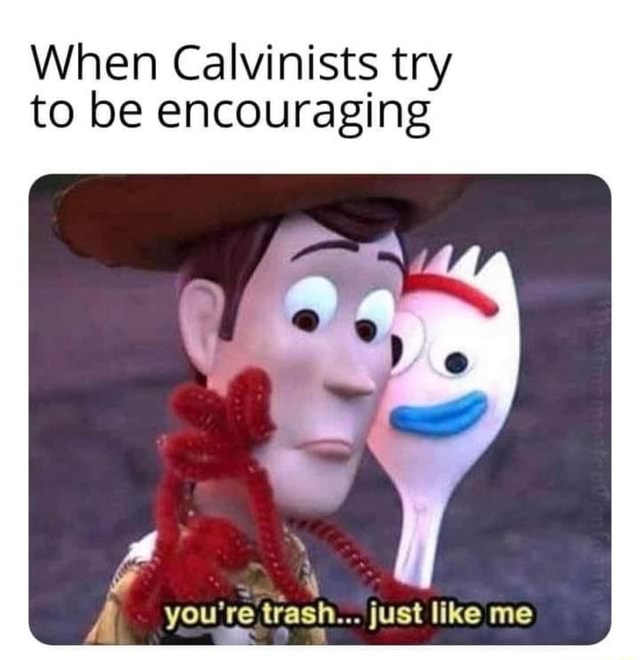
The theology came last. It always does, for anyone honest about the order of operations. And the theology cleanly fits into Calvinism aka Reformed Christianity. Which is helpful for sorting out local churches, but not much else. Faith and religion should never be a team you play for. The stakes are too high. You have a country, a family, maybe a sports team you can swear allegiance to. But concerning our Creator and questions of eternity, your only fealty should be to the truth... as clearly as you can discern it.
Written by
Join Us
Free subscribers get weekly essays on morality, culture, and character through fiction. Paid subscribers get everything.








Member discussion